I recently subscribed to the Llewelynn mailing list and this article has just come through via e-mail and after my post about voodoo, I thought it sort of "fitting" to copy across. Please note that this is not a post which I have written, but is an extract from an email.
Being a Witch: Inner Recognition, Love for the Earth, and Ethics
In my latest Witchy Update, I asked readers "What makes you a witch?" Your answers varied from the supremely practical - as BlackSerpent Nightshade put it, "My 'church' can be anywhere I like ... outside, inside, at my home or someone else's. I can pray in the shower, in bed, at work, alone, with others, during the day, at night ... whenever I like" - to the utterly poetic.
Here I have to share the words of Aurora Jet with you: "To be a Witch is to worship the Goddess, in all Her forms and ways, and to follow the Craft of the Wise. This can manifest in my awe of a misty orange-pink dawn, a blustery storm, the trembling of an earthquake, the tides of the sea, the stones that speak. It can be the hummingbird hovering just six inches away from my nose, its tiny black-bead eyes gazing directly into mine. It can be the raven flying over head, 'cawing' a greeting. It can be the grizzly she-bear who follows me in my dreams. It can be the ability to perform a spell and see it come to fruition. It is power, tempered with wisdom and compassion. It is remaining calm when dealing with those who may be difficult. It is trust in the face of adversity. It even prompted me to write poetry again, a way of expressing myself in spells, chants, or my inner voice."Most respondents in some way had always felt deep inside that they were witches, whether they knew what that was at the time or not. This sometimes manifested as a sense of being different; Laura says, "I was more attuned to nature than others and recognized an inner 'gut feeling' that guided me in everything I did. I always felt that my higher power was female and a goddess, not a god."
For many of us, it just took time to recognize what this different feeling was. Phoenx writes, "My answer is, the knowing...even when I don't want to. It had been suppressed for so long, but one day I couldn't hide from who I was anymore."Other times this feeling was simply one of not being able to connect with traditional religions and searching for something more. Venessa remembers "even as a small child being fascinated with the living planet and having a great deal of difficulty understanding (at 5 years old) the concept of a Christian god. After all, don't both parents nurture and protect?"
And BlackSerpent Nightshade wrote, "I have contemplated many religions in my area and none of them seem to 'fit' me. I saw a lot of talk and not many wanting to follow what they were preaching. For me, that wasn't what I wanted to do. I was a baptized Christian, and maybe somewhere else there is a better ... connected church, but here there is not. And I didn't fit in really. [...] When I was at my lowest times, these places weren't there for me...I was alone spiritually."Another thing you'll notice about the responses is that witchcraft really leads us to want to be good people, which should be the bottom line in any pursuit of spirituality! This includes acting ethically with other people and with the environment.
Laura shares: "I recycled when I was a child in the 50's and still do. I pick up garbage on the beach or in natural surroundings in order to bring nature's bounty into balance. I have always been aware of the harm we do to our environment and I have always - always - tried to do no harm to anyone or anything. It is as if Mother Nature herself asks me to tidy her up. I sense her at all times in my life. [...] I have recently changed my buying habits after shutting off my TV for over a year while I returned to school to get my bachelor's degree. I buy natural foods and respect the power and the symbiosis of mind and body. I strongly respect and am grateful for the blessings that Mother Earth has given me in particular. I care for myself now. I am in better health than I was in my 20's, 30's & 40's. Turning off the TV has made me more aware of the loud noise and the psychic influence of marketers in American society. I am no longer easily influenced and am actually quite ashamed of being manipulated by mass media and advertising for so many years. I believe that being a pagan and a witch has created a higher ethical standard in my life than in other people. It is a question of devotion, love, and respect for all living creations."And she's not alone.
BlackSerpent Nightshade writes, "I acknowledge the animals that live on the Earth as my brothers and sisters now, and not just as creatures that humans can move wherever they want whenever they want. I feel the pain the Earth goes through as we continue to destroy the gift she has given us ... a place to live ... that we carelessly throw away. I try to recycle whatever I can and not buy things in aerosol form. I try to do things every day that helps someone else, without expecting something in return ... treating others as I would like to be treated."Being a witch is really a full-time job, not just something to drag out of the closet at Halloween.
Heather writes, "I am a Celtic earth witch 7 days a week 24 hours a day and EVERYTHING I do is why, how, what and because of it!" BlackSerpent agrees: "I don't just try to practice rituals and celebrate the Sabbats ... I try to live being a Pagan. Let it seep into every part of my life, every part of my day and night so that it is my life that is lived Pagan, and I am not called it just as a term to be called."And one reader, Josephine, reminded us all of a key factor in being a witch: tolerance."Part of being a witch is to understand and accept that others will have their own beliefs. Not just other witches, but the Christians, Judeo, Muslim, Native American, Buddhists. None of us is wrong, we simply have different beliefs. We ask for understanding, but first we must understand, tolerance begets tolerance and so forth. So let's celebrate each other's differences! [...] While saluting our flag the words may be 'In god we trust.' I can think 'Goddess' to myself, while acknowledging and respecting that this country was indeed based on Christian values.
We can attend a Christian (or whatever) church service and respect those who believe--we are their guests in their church. I would not miss a dear friend's wedding or funeral because there would be a service from a different faith. And I even proved a point recently at a friend's mother's funeral--witches do not melt when splashed with holy water. Just a thought from this old crone."
Well said, Josephine.You'll find below an excerpt from our new book, Witch in the Bedroom, which further enhances the way you bring your spirituality into your attitudes and beliefs about relationships so you can find one that truly works for you. Then more summertime love and pleasure follows in an article by Stephanie Rose Bird. Don't forget that a great way to be pagan everyday is by getting together with the community, so in the links section you'll find a few links to group and festival calendars. Get out there and have some fun this summer!
—Elysia Gallo, Acquisitions Editor - Witchcraft, Paganism, Magic
Friday, June 23, 2006

Voodoo
I have, suspiciously, always steered clear of voodoo, its connectations to me were dark savages on plantations doing dark magic to oust the owners, of slaughtering animals to use their blood in rituals and other such nasty things. These images mainly come from reading "historical" romances whilst growing up set in the South (of America), New Orleans etc. and also a few dark movies like Angel Heart back in the 80's.
I was on the BBC news website and found a pictoral interview with a voodoo priestess. The photos spoke of deep devotion, her words of honouring their Gods were deep and beautiful and I actually berrated myself for - one moment - forgetting that other people look down on paganism in general and seeing it as nonsense, or something less impressive than the Judao Christian religion so predominant in the world. I was being negative and biased. Voodoo is stil a scary religion to me, as preconceptions are very hard to let go of, but just reading her words and seeing her do some of the rituals made me realise that religion, no matter what its brand or "primitiveness" is, is the practice to honour and revere the gods, take care of one another and help others and yourself to be better people, to struggle with your own spiritual demons and have someone be there to help struggle with you.
I will copy and paste the text from the Beeb here, and hopefully some of the pictures if Blogger doesn't crash, as it has been doing.
Nope, it isn't allowing me to post any pictures. And blogger isn't allowing me to post the html code, which is annoying, but I am sure if you go to the bbc website and search for voodoo priestess it should come up.
Spiritual force
Voodoo is a state religion in Benin - the West African country where the practice started, before being taken to Haiti and elsewhere by slaves.
Some 65% of the seven million population are adherents. They say it is a positive force, bearing little resemblance to the popular image of people casting evil spells by sticking pins in dolls.
Priestess Na Danon says the word "Voodoo" means both the religion and the spiritual forces within natural phenomena such as water, fire, earth and air.
Sacrifice
"When you want to ask the voodoo for something, you have to give something in return - as a sacrifice.
"This is usually something to eat or drink, such as a chicken or some alcohol.
"Now he can help you. If he helps you, and you get more money and goods, you can come back with more offerings to ask for more."
Sand heap
"For a sacrifice, I cut the throats of two chickens, one male and one female and feed them to the shrine.
"When you see the voodoo [spirits], you see a heap of sand. But inside this sand are the spirits. So when we pour blood on the sand heap, we get a reaction from the spirits inside the hill.
"There is Mary and Jesus in Christian belief. In voodoo, there is male and female. When we want to make sacrifices, we call on the female first, before calling the male."
Worshippers
"I became a voodoo priestess like Jesus Christ came to earth. Jesus came from the skies. I came back to this life as a voodoo priestess.
"You cannot volunteer to become a voodoo chief, it is your life, and your only way of staying alive.
"I cannot count how many people come to see me. I have more than 200 followers. On big festival days this whole house is full of worshippers.
"People come to ask for help - to get a job or to cure an illness."
Abusing voodoo
"When you are ill, we perform ceremonies here and the person gets better.
"If people say voodoo is bad, that means they don’t understand it.
Voodoo is God. If God says: 'Follow me, do not turn to the left or turn to the right, just walk straight ahead,’ then you do that.
"Voodoo is the same. Voodoo is not used to do bad things, only for good. There are people who use it for evil purposes, but they are not respecting the religion."
"There are eight voodoo priestesses in Ouidah - Benin's voodoo capital. My grandfather was a voodoo priest. When he died I succeeded him."
Long life
"When I get up in the morning I go to the house of the voodoo, and ask for peace for everyone in my house, in Ouidah, all over the country and the whole world. My role is to ask the Gods for peace.
"A voodoo priestess enjoys good health and a long life. If I do a ceremony for you, good things will happen for you. You will remember me, and maybe send money to me."
Protect others
"When nobody comes to ask for a sacrifice, I sit down on my favourite chair, and I watch television. I look out for everything that is happening in the world.
"If there is a war somewhere, I will pray for peace. It might be in Ivory Coast, or Iraq, I will pray for peace there.
"I will tell you one thing: if you are a voodoo priestess, your only work is to protect others, and ask favours of the voodoo spirits."
Interview and photos: James Copnall
I was on the BBC news website and found a pictoral interview with a voodoo priestess. The photos spoke of deep devotion, her words of honouring their Gods were deep and beautiful and I actually berrated myself for - one moment - forgetting that other people look down on paganism in general and seeing it as nonsense, or something less impressive than the Judao Christian religion so predominant in the world. I was being negative and biased. Voodoo is stil a scary religion to me, as preconceptions are very hard to let go of, but just reading her words and seeing her do some of the rituals made me realise that religion, no matter what its brand or "primitiveness" is, is the practice to honour and revere the gods, take care of one another and help others and yourself to be better people, to struggle with your own spiritual demons and have someone be there to help struggle with you.
I will copy and paste the text from the Beeb here, and hopefully some of the pictures if Blogger doesn't crash, as it has been doing.
Nope, it isn't allowing me to post any pictures. And blogger isn't allowing me to post the html code, which is annoying, but I am sure if you go to the bbc website and search for voodoo priestess it should come up.
Spiritual force
Voodoo is a state religion in Benin - the West African country where the practice started, before being taken to Haiti and elsewhere by slaves.
Some 65% of the seven million population are adherents. They say it is a positive force, bearing little resemblance to the popular image of people casting evil spells by sticking pins in dolls.
Priestess Na Danon says the word "Voodoo" means both the religion and the spiritual forces within natural phenomena such as water, fire, earth and air.
Sacrifice
"When you want to ask the voodoo for something, you have to give something in return - as a sacrifice.
"This is usually something to eat or drink, such as a chicken or some alcohol.
"Now he can help you. If he helps you, and you get more money and goods, you can come back with more offerings to ask for more."
Sand heap
"For a sacrifice, I cut the throats of two chickens, one male and one female and feed them to the shrine.
"When you see the voodoo [spirits], you see a heap of sand. But inside this sand are the spirits. So when we pour blood on the sand heap, we get a reaction from the spirits inside the hill.
"There is Mary and Jesus in Christian belief. In voodoo, there is male and female. When we want to make sacrifices, we call on the female first, before calling the male."
Worshippers
"I became a voodoo priestess like Jesus Christ came to earth. Jesus came from the skies. I came back to this life as a voodoo priestess.
"You cannot volunteer to become a voodoo chief, it is your life, and your only way of staying alive.
"I cannot count how many people come to see me. I have more than 200 followers. On big festival days this whole house is full of worshippers.
"People come to ask for help - to get a job or to cure an illness."
Abusing voodoo
"When you are ill, we perform ceremonies here and the person gets better.
"If people say voodoo is bad, that means they don’t understand it.
Voodoo is God. If God says: 'Follow me, do not turn to the left or turn to the right, just walk straight ahead,’ then you do that.
"Voodoo is the same. Voodoo is not used to do bad things, only for good. There are people who use it for evil purposes, but they are not respecting the religion."
"There are eight voodoo priestesses in Ouidah - Benin's voodoo capital. My grandfather was a voodoo priest. When he died I succeeded him."
Long life
"When I get up in the morning I go to the house of the voodoo, and ask for peace for everyone in my house, in Ouidah, all over the country and the whole world. My role is to ask the Gods for peace.
"A voodoo priestess enjoys good health and a long life. If I do a ceremony for you, good things will happen for you. You will remember me, and maybe send money to me."
Protect others
"When nobody comes to ask for a sacrifice, I sit down on my favourite chair, and I watch television. I look out for everything that is happening in the world.
"If there is a war somewhere, I will pray for peace. It might be in Ivory Coast, or Iraq, I will pray for peace there.
"I will tell you one thing: if you are a voodoo priestess, your only work is to protect others, and ask favours of the voodoo spirits."
Interview and photos: James Copnall
Monday, May 01, 2006
Beltane
Apologies for the late posting of this - for some reason Blogger would just not process this post, at all! So, here it goes, again!
Happy Beltane to all!
What an odd day it has been, weatherwise. Early this morning the weather was cold and wet and dreary. I crawled back into bed and woke up at half nine and the sun was shining brightly and the world looked washed anew.
I haven't had a chance to prepare anything myself but as an avid visitor to loads of websites I found a few choice articles to visit:
http://www.witchvox.com/va/dt_va.html?a=usma&c=holidays&id=2765
http://www.witchvox.com/va/dt_va.html?a=usma&c=holidays&id=3382
http://www.bbc.co.uk/wiltshire/moonraking/summer_solstice.shtml
http://www.bbc.co.uk/print/religion/religions/paganism/festivals/beltane.shtml
We spent the day tidying the house after yesterday's party - Marcus turned 33 and we celebrated with a few friends, a lot food and no one noticed the few candles I had burning, a subtle nod to the fire festival we couldn't really have as the weather wasn't particular nice. We took Sparrow out for a long lazy walk in the park and I noticed that the trees that were bare last week has suddenly come to life, thanks to a few days worth of sunshine and a few spitterings of rain during last week. Even our old and rather withered tree in the back garden has started sprouting new leaves and it genuinely means that Spring and Summer is underway.
Here's hoping it is a good year and that there will be rain aplenty for the crops to survive.
BB
Monday, April 17, 2006
Religious Intollerance

I have given myself a few days to calm down after receiving an email from a family member. Fortunately, not blood family, but an add-on. If it were blood family, I don’t know what I would have done. As it is I hardly have any contact with “it” anyway and from now I definitely won’t want anything to do with them as they have just proved to me that narrow mindedness is catching.
The email in question started off innocently enough, telling me what they were up to for the Easter weekend. And then, unexpectedly, the following was inserted into the email:
to day until 2 morrow we fast for our heathen foreign families praying they dont die and burn in hell ........ then have communion and chomp a few hot - x - buns to break the fast after the easter service.
And I think to myself – in the words of Marcus – WTF? Where in all the world did that comment come from? What prompted it at all? Did add-on family member and its wife eventually lose their minds and join a cult of some sort? Never in my wildest dreams have I ever said anything about their religion, about my own beliefs, or anything of the sort...
I think they must have because I have NEVER in my life had anyone, even jocular, say anything to me like that. My outrage is genuinely beyond words. What makes me shake my head is that they are Rice Christians – do you know what Rice Christians are? – they “converted” to Christianity to have a white church wedding a few years ago.
At first it was jocular and then in the end, all the dogma sank in. We thought, fantastic, good for them. Fabulous thing to do, get religion, some direction. They have been after all, been living in “sin” and suddenly, once they got engaged and went to church, oops, no sex, sorry. Only for married people. They got married in a hair raising “halleluja” service. She looked lovely in her dress though. And the food was nice. She did swear like a trooper at the party and danced like a mynead. He just leered all the girls and regretted his choice of getting hitched.
Then, they started going to church, for real. Then of course they started on us. Come to church, blah blah. We never took them up on any of their offers. I grew up in a highly Christian household and after 24 years of going to church 3 times a week, teaching Sunday School and singing in the choir, and belonging and running the church youth group, I have had enough. I now believe what I believe, I am a searcher and have read tonnes of books on theology, mysticism, gnostic gospels and everything else I could lay my hands on as I was trying to find something that resonated better than an angry god that hated women, that encouraged bloodshed and did nothing to stop the wars raging across the world. I can form my own opinions now, thank you very much, I don’t need some pretend-priest of some scattered branch of some obscure fragment of a denomination to preach at me and tell me if I don’t repent, I will burn in hell, that as a woman I am worth less than a man and that all we are good for is to support our “men” and be good wives, tending to our many children as birth control is a sin.
And now this email! After a few other veiled comments like this: “maybe you should go to church sometimes, pray for your souls”, I think, said add-on family member can go and fly a kite in a thunderstorm. And the funniest thing is, sober they are religious and don’t swear and behave relatively normally (and listen to nice church approved music) but give them a drink and by the gods, they are back to their old ways, as easy as that, drinking, swearing and smoking and carousing. Rice Christians, they are a funny lot. I am so glad I haven't seen them in almost five years. I don't think I would be able to control myself if I ever had to see them again.
Triskelion Spell - To Protect a Traveller
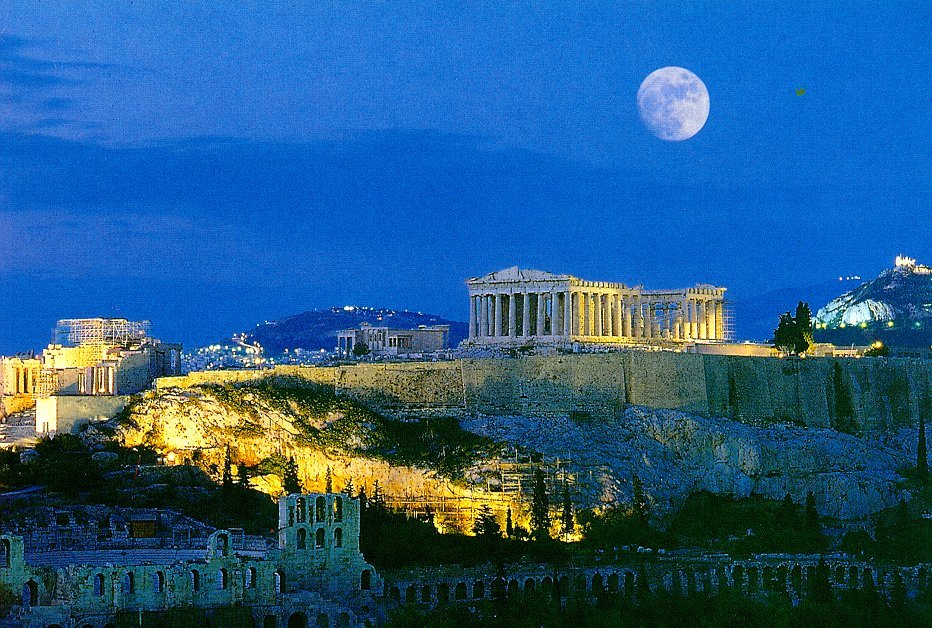
This spell is to protect you on your travels.
Background:
The word "triskelion" comes from the Greek language and means "three legged". It is a very old symbol that has been ascribed many meanings through the ages and that is inevitably bound up with the mysterious nature of triplicities.
How to cast the spell:
One pale blue candle, 15 - 20 cm in length
Matches/lighter
One small single scallop shell, drilled
One fine paintbrush
One tube of vermillion paint
One length of 60cm cord
Timing - cast on a waxing moon and on a Sunday, sacred to the sun.
Casting the spell:
- Cast a circle
- Light the candle saying:
"Hermes of the skies
Hermes the traveller
Look well upon (insert name)
That they are hale going out
And hale coming in."
- Paint on the inside of the scallop shell the outline of a triskelion.
- Sit in the centre of the circle with the upturned shell in your upturned right palm, which should be placed over your upturned left palm. Close your eyes and visualise the triskelion you have painted spinning clockwise, faster and faster until it is a blur.
- When you are ready, blow onto the shell with your breath to bless it with power of air. When the paint dries, threat it with the chord and dip it into natural saltwater at the earliest opportunity.
- The triskelion pendant should be worn around the neck of those who would call on its protective powers.
Monday, April 03, 2006
Witchy Con in retrospect...
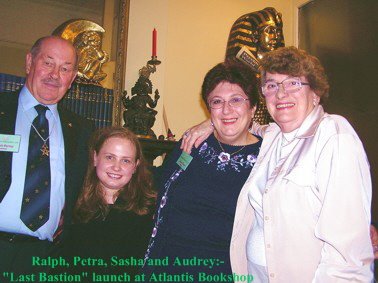 Ralph on the far left with Audrey on the far right


Hello fellow crafters
This Saturday past - 1st April - saw the second Witchy Con take place at Wantage in Oxfordshire.
We arrived early enough, got parking and made our way to the Civic Hall where we were met by smiling faces and a very calm Judith of New Moon. We registered, got our name badges and our familiars badges and after pausing at the raffles table to admire all the very pretty prizes, we went upstairs for the opening ceremony. Judith is fantastic as a spokes person. She is funny and warm and had everyone smiling as she invited everyone to shop till they dropped and to attend as many of the talks and workshops as they could.
The whole day went well - she cleverly scheduled a lunch break for everyone and no workshops or talks were held during this time. All of the workshops and talks were free, included in the price of £10, which was a bargain.
Marcus and I attended the first talk of the morning by Sally Morningstar on Wiccan Healing. It was a very solemn talk and I genuinely took some new notions away with me. We wandered away to the dealers room, did a quick scout around and I bought two lovely bracelets - one depicting the 22 major arcana tarot cards and the other a sort of a charm bracelet. There weren't many traders in the hall, but they had good quality goodies and of a varied hue, so that really made a good impression. I shot off to listen to the Ralph Harvey talk whilst Marcus scooted off to take some photos of the Tarot workshop.
Wow - Ralph Harvey is such a genuinely knowledgeable gentleman with a keen sense of humour. And the amount of knowledge he has to draw from 52 years in the craft and with his wife and partner, Audrey they have seen so much and have been the catalysts in the world of the Craft for such a long time, that it was a genuine treat to listen to him. He talked lovingly about his history and told interesting antecdotes of his research. He is the author of a book called The Last Bastion - it explores the history of Witchcraft in England and especially in Sussex - the last county in England to embrace Christianity and the first to re-embrace Witchcraft once the Witchcraft Act was repealed in 1951.
We broke for lunch, came back and I sat in on John Dee's talk on Egyptology. A huge, vast and very interesting subject to cover in an hour. He did his best though and had us lapping it up - his style was humourous and jocular but informative. Yet another person to corner in a pub to sit down and talk to for hours.
John Dee 
Afterwards I had the good fortune to sit down and chat with Ralph Harvey and his wife and I must say that they were wonderful. Marcus joined me and we sat, like days of old, before our elders, listening to tales told and of their adventures. I asked Ralph if he would ever consider writing his autobiography and he said no, quite vehemently. He went on to explain that so many things have happened in his life, personal and career wise that most people will expect it to be untrue. He launched into a story that had us gasping with laughter, it was so preposterous, yet true, by all accounts as Audrey backed him up on it. We could see that they were a dynamic couple, having got that intrinsic link that true soul partners have, finishing each other's sentences etc. We must have chatted in excess of forty minutes or so and both Marcus and I came away feeling like we have spent time with two very genuine and lovely people. They invited us to stay in touch - something which I think we will do.
Marcus flitted about, in a manly way, posing people for photographs and general making everyone touch up their make-up. I sat in on part of the Anna Franklin talk and too soon the day was over, with Judith closing the day down. Then the real fun started - the raffle! We all crowded around, around 200 of us, waiting to see if we had won anything. Sadly, my strip I bought came nowhere. However, they did a further draw based on our pre-registered badge numbers and I won! I darted forward and chose a Ly de Angelis book called The Quickening. Exciting stuff! We did a last zoom around the traders hall, waved goodbye to Judith and her team and drove home.
It was a good day. It was well attended, but there is scope for more people to attend. The talks I attended were brilliant and I enjoyed them thoroughly. I will definitely be going again next year.
List of traders attending: http://www.witchycon.co.uk/dealers.htm
Thursday, March 16, 2006
Some bragging rights...
 Image courtesy of: http://www.kristinsweetland.com/onroad2003.htm
Dear friends and visitors
I was struck by the high volume of visits the site has recently had so I did some investigation (because I am vein) and discovered that if you typed in some phrases like Witchy Con (and some others, but since WC is close to our hearts, we'll stick with that example) on Google...well, by Odin's Thunderbolt....our smidge of a website comes up! How unutterably cool and wildly exciting is that!
I thought that it would be really excellent to celebrate that with a recipe for some divine ginger nut and chocolate chip cookies!
Ingredients
2 oz (50 g) dark chocolate (75% cocoa solids), chopped into little chunks
1 slightly rounded teaspoon ground ginger
4 oz (110 g) self-raising flour
½ oz (10 g) cocoa
1 level teaspoon bicarbonate of soda
2 oz (50 g) butter, cut into cubes
1½ oz (40 g) golden granulated sugar
2 oz (50 g) golden syrup (about 2 tablespoons)
Pre-heat the oven to gas mark 4, 350°F (180°C).
You will also need a 11 x 16 inch (28 x 40 cm) baking tray lined with baking parchment.
Begin this by sifting the self-raising flour, cocoa, ginger and bicarbonate of soda into a mixing bowl. Then, using your fingertips, rub in the butter until the mixture resembles breadcrumbs and next stir in the sugar and chopped chocolate. Now add the golden syrup, then mix everything with a wooden spoon and finish off by squeezing the mixture together with your hands.
After that, divide the mixture into 16, and roll each portion into a ball. Place on the lined baking sheet, very well spaced out as they will spread out quite a bit during cooking, flatten each one slightly, then bake on the centre shelf for 15-20 minutes, or until they have spread out and turned cracked and craggy. Cool on the baking tray for a few minutes then, using a palette knife, remove to a wire rack to cool completely.
Wednesday, February 22, 2006
Witchy Con
 I am happy and proud to announce that hubby and I will be going to Witchy Con this year. It is only in its second year (I think) but is becoming more popular. It is being held in Wantage and the price for entry is £10 - and this will get you free coffee and tea during the day, free entrance to all workshops and talks and that leaves you extra money to spend on the trading hall. You also get a goodie bag with magazines, book chapters and who knows what else she can rustle up!?
Witchy Con is the brainchild of Judith Lewis ... oh blah, let me just copy and paste the blurb from her website:

WitchyCon is the brainchild of Judith Lewis, a lightly seasoned conrunner (even better in a white wine sauce) and David Row, an overseasoned conrunner. Both have extensive experience creating and running a variety of conventions across different subject matters close to their heart. Having already worked on or with Fantasy, Science Fiction and Anima conventions, one interest was left unconventioned - Paganism, Witchcraft and Magick.
Having experienced a variety of conferences and constantly muttered about how they should have been done differently, the pair have put their money where their mouthes are (and feet and copious amounts of Malteesers) and organized WitchyCon. This convention brings to the pagan market all the things each liked from their respective conrunning experiences.
WitchyCon is meant to be an experience. You do not need to know a single thing about paganism or anything witchy as the whole purpose is to educate in a fun way. Each talk touches upon a different aspect from the world of paganism and presents a great opportunity to learn without needing to know anything before hand. New friends are made, old ones revisited and fun is the theme of the day.
Belated Imbolc Post
I must admit to being a lazy mare.
I was so wrapped up in my own things (planning my birthday) at the beginning of February that the Imbolc celebration flew by and I had not given it any thought.
So I thought that I would make up for it quickly before its time to actually post about the Spring Equinox in March!
I was so wrapped up in my own things (planning my birthday) at the beginning of February that the Imbolc celebration flew by and I had not given it any thought.
So I thought that I would make up for it quickly before its time to actually post about the Spring Equinox in March!
***

Imbolc (pronounced 'im'olk' also known as Oimelc) comes from an Irish word that was originally thought to mean 'in the belly' although many people translate it as 'ewe's milk' (oi-melc).
Imbolc was one of the cornerstones of the Celtic calendar. For them the success of the new farming season was of great importance. As winter stores of food were getting low Imbolc rituals were performed to harness divine energy that would ensure a steady supply of food until the harvest six months later.Like many Celtic festivals, the Imbolc celebrations centred around the lighting of fires.
Fire was perhaps more important for this festival than others as it was also the holy day of Brigid (also known as Bride, Brigit, Brid), the Goddess of fire, healing and fertility. The lighting of fires celebrated the increasing power of the Sun over the coming months. For the Christian calendar, this holiday was reformed and renamed 'Candlemas' when candles are lit to remember the purification of the Virgin Mary.
Imbolc is still a special time for Pagans. As people who are deeply aware of what is going on in the natural world they recognise that there is strength in cold as well as heat, death as well as life. The Horned God reigns over the Autumn and Winter and and although the light and warmth of the world my be weak he is still in his power. Many feel that human actions are best when they reflect the actions of nature, so as the world slowly springs back into action it is time for the small tasks that are neglected through the busy year. Rituals and activities might include the making of candles, planting spring flowers, reading poetry and telling stories.
***
I must say that reading the last sentence : Rituals and activities might include the making of candles, planting spring flowers, reading poetry and telling stories : has really made me feel tonnes better. That is exactly what I have been doing, besides neglecting my poor witchy site so badly. Writing or rather, telling stories. I am rubbish at writing poetry but reading it is something that I love - hence the random pieces that I post now and again.
So, in theory, eventhough I didn't really do anything consciously for Imbolc I was there, doing my story telling. Now, all I have to do is pay attention to the upcoming celebrations for the rest of the year!
Tuesday, February 14, 2006
THE SPIRIT GUIDE

Thou Spirit of Wisdom who guides me,
From out of the Shining World to attend me,
The shepherding kind of the fold of faerie kin
To make round about me this night;
Drive from me every ill-will and danger,
Surround me on the sea of the unholy,
And in the narrows, crooks, and straits,
Keep thou my coracle, keep it always.
Be thou a bright flame before me,
Be thou a guiding star above me,
Be thou a smooth path beneath me,
Be thou a kindly wind behind me,
Today, tonight, and for ever.
And when I grow weary and I become
A stranger in this land,
Lead me to the Land of Promise;
For it is time for me to go home .
Saturday, January 28, 2006
Landmark and sacred trees

I was looking through all the things I had on my hard drive and found this and thought it might make an interesting read for all my visitors interested in all things green and beautiful.
Landmark and sacred trees of Leicestershire and Rutland
Penny Drayton
Almost universally trees have been venerated and believed to be the dwellings of Tree Spirits, sometimes called Dryads. Deliberately planted groves of sacred trees, such as oak, elder, ash, rowan and hawthorn, were probably the earliest man-made sacred sites. Greek and Roman temples with their columns and decorated capitals may be thought of as an architectural continuation of such groves. Tacitus described the sacred groves in Germany during the Roman period. Closer to home, the importance of tree mythology to the ancient Celts is well-known, in part through Robert Graves' imaginative reconstruction in The White Goddess which explores in detail the tree alphabets and related lore [1].
As late as the eleventh century Cnut was proclaiming laws which prohibited people from owning land which was a sanctuary centred on a tree. St Boniface cursed an oak dedicated to Thunor yet the Old Norse place-name element lundr (meaning '(?sacred) grove' but usually corrupted to 'land' in modern spellings) remains common in England as well as Scandinavia. Many hundred moot places have names ending in '-tree', often prefixed by a personal name, and such names may relate back to the ancient sanctuaries around sacred trees; examples from Leicestershire are given below.
Predictably no trees have survived from pre-christian times and even the Gospel Oaks, where the early missionaries preached, have all gone. The surprisingly abundant evidence for sacred trees comes mostly from place names and folklore as this article will attempt to show, even though it is based only on my researches in Leicestershire and Rutland.
It is worth noting that in Leicestershire the characteristic hedgerow tree is the ash. Oaks and elms have always been less abundant than in most other parts of England. It is difficult to explain this; it may be because the soil conditions were favourable to this species, although there are no surviving woodlands where ash is the predominant species. This part of England was probably largely de-forested before the Roman invasion and all trees and woodland can be regarded as managed rather than natural. Hedgerow trees in particular are usually deliberated planted, or at least deliberately allowed to grow by the hedge trimmer.
Ash makes strong, light timber and excellent fire wood and was no doubt considered a valued species. But could there be deeper reasons for its popularity? It is clear that the ash was sacred to our forefathers - Pliny wrote of their power as protection against snakes and even the shadow cast by an ash was said to be avoided by snakes. The Belgic bronze age invaders apparently worshipped the ash, under the name Gwydion. The Saxons and Danes held ash trees in especial esteem, as Yggdrasill, the Sacred World Tree, was usually described as an ash. Ash is still the favourite wood for walking sticks, a reminder of the tree's power as a sacred ashen spear. Ash was also a favourite herding stick and the proper wood for making shepherds' crooks. A bunch of ash keys was considered a powerful guard against witchcraft.
Whether or not ancient inhabitants of this county encouraged the ash for practical or propitious reasons, they certainly had at least one Great Sacred Grove on the edge of the county. Vernemetum was a Roman town which stood at the crossroads of the Fosse Way and an ancient Salt Way (129:648249) and its name means 'Great (or Especially) Sacred Grove'. This suggests that the site was sacred in late iron age times, presumably being a Druidic grove. Although little archaeological investigation has taken place and nothing is known of its role in the Roman period the site was still important in the later Saxon period as the eighteenth century antiquarian, Stukely, refers to a legend of the ruins of a Saxon church standing in a place known as The Wells. Recent finds by metal detector users seem to confirm the site. On the ridge of the hill, at the crossroads itself, several Saxon barrows were excavated in the 1960s, although the excavation reports have not so far been published.
Moots at trees
As has already been suggested, ancient moot sites may be the last vestiges of ancient sacred enclosures based on tree worship. Towards the south of the county the now-obsolete administrative area of the Gartree Hundred derived its name from geirtre which means 'a tree with an overgrown gash or goitre' - a useful landmark for a moot place. Indeed, throughout Britain '-tree' is a very common part of Hundred names and Leicestershire is certainly no exception. The meeting place of the Sparkenhoe Hundred was probably at Shericles Farm near Desford (140:467026), which derives from scirac meaning "the hundred oak". Another moot took place in Oadby at a place called Spelthorn - 'a thorn where speeches are made'. Framland Hundred derives from 'Faena's grove', which is almost certainly the wood still surviving north of Melton Mowbray at 129:747224. The earlier interpretation of lundr as 'sacred grove' has recently been dismissed by Margaret Gelling, a notable expert on place-names, who interprets the word as simply 'small wood'. Another example of lundr in Leicestershire is Swithland (129:5412); Gelling attributes this to 'burnt-clearing wood' [2].
The meeting place of the Gartree Hundred was well-known as late as the end of the eighteenth century when Nichols described the 'Gartree Bush' in detail. It was situated just to the north of the Roman Road known as Gartree Road and west of the ancient ridgeway running north-south (141:716974)
There is a second Gartree name in Leicestershire, Gartree Hill south of Melton Mowbray (129:760145). Presumably this too was marked by a 'goitred' tree which once had particular significance as a landmark - the hill forms part of the ancient trackway running directly north-south between the hill fort at Burrough on the Hill (761120) and Melton Mowbray.
Oaks
The splendidly suggestive village name of 'Holy Oaks' relates to a now-deserted village south of Stockerston (141:845956). Nothing is known of the origins of this place-name.
Three Shire Oak marked the boundary of Leicestershire, Lincolnshire and Nottinghamshire (130:822429). On earlier maps it is shown as 'Three Shire Bush'. Originally there was also a standing stone here, called the 'Star Stone' which was reputed to have fallen from the sky.
Copt Oak in Charnwood takes its name from a pollarded oak which stood until 1855 in the corner of the churchyard (129:483128). It was said to be two thousand years old. Certainly it was the meeting place for the old forest swanimotes and later was a Civil War rallying point. The church and churchyard are merely nineteenth century intrusions on the site.
White's Directory for 1864 said it was fashioned in the form of a 'Tau' by careful removal of all branches except two. The trunk was said to be 20 feet tall and more than 21 feet in circumference. However an early nineteenth century illustration in Nichols shows only a hollow trunk with small branches growing out of it in a natural manner.
There was at least one other Copt Oak in the county. There is a farm of this name near to Narborough (140:531978).
Abbot's Oak is the name of what is know a farm to the north of Bardon Hill (129:463143) and just up the road from Copt Oak in Charnwood.
In the churchyard of St Peter's, Belgrave (140:5907) was an extremely ancient oak called 'Main Oak'. The churchyard is also reputed to be haunted by a white lady.
When the so-called "nine day's queen", Lady Jane Grey (who actually reigned for thirteen days), was beheaded the oaks at her home in Bradgate Park (129:5311) were reputedly pollarded as a sign of mourning.
An oak was planted in front of the rectory in Burton Overy (141:6798) at the Restoration from an acorn of the famous Boscabel oak. A near neighbour was grown from its acorn on the Diamond Jubilee of Victoria; today only this tree survives.
A so-called Domesday Oak stands near Rutland Water at Edith Weston (141:9205). (Also nearby, at Normanton Park Hotel, is one of Britain's oldest cedar trees.)
Other trees
Between Holywell Haw and Nanpantan to the west of Loughborough there used to stand a 'sweating tree'. It was also distinctive because it blossomed twice a year, in spring and autumn.
An ancient hollow elm used to stand in the churchyard at Sileby (129:600152) from under which the vicar is said to have distributed oranges to children on Whit Monday [5]. Interestingly, the eighteenth century engraving in Nichols does not show such a tree; there is no such tree today.
On a map of 1777 a crossroads in the west of the county is shown as 'Hoo Ash'; this is now the centre of Coalville (129:429141) [4].
References
1: R. Graves, The white goddess, Faber, 1961. 2: M. Gelling, Place-names in the landscape, Dent, 1984. 3: P. Devereux, 'The forgotten heart of Albion, pt1' in The Ley Hunter, No.66, pp9-12, 1975. 4: J.D. Welding (ed.), Leicestershire in 1777, Leicestershire Libraries and Information, 1984. 5: R. Palmer, The folklore of Leicestershire and Rutland, Sycamore Press, 1985.
Originally published in Mercian Mysteries No.9 November 1991.
(image placeholder)
At the Edge home page
http://www.indigogroup.co.uk/edge/
Copyright 1991, 1996, 2001. No unauthorised copying or reproduction except if all following conditions apply: a: Copy is complete (including this copyright statement). b: No changes are made. c: No charge is made.
At the Edge / Bob Trubshaw / bobtrubs@indigogroup.co.uk Created April 1996; updated May 1998
Monday, January 02, 2006
A Litany, a mantra, a plea
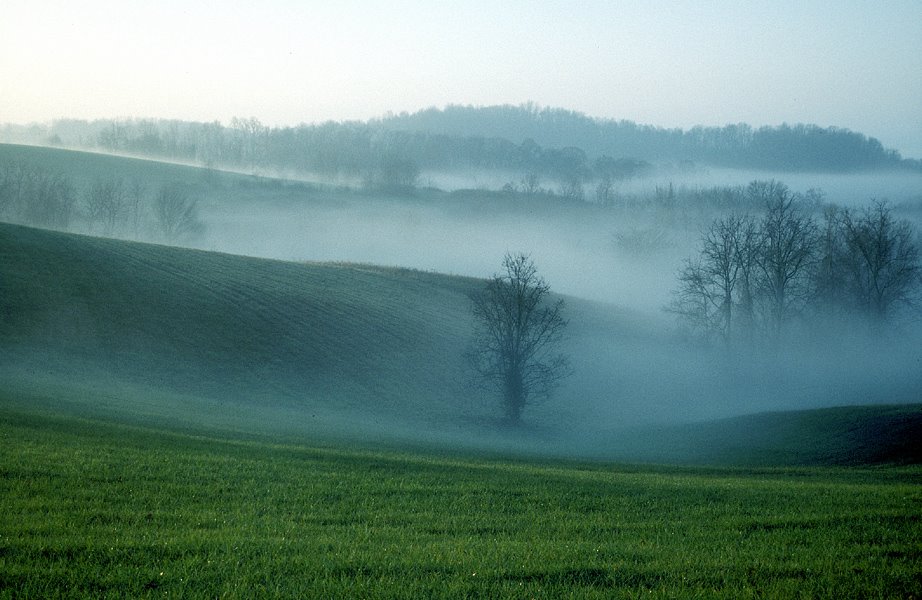
We stand in your place, Ancestors
We perform your deeds, Ancestors
Do not forget, do not forget,
Let it be these words, Holy Ones,
that my heart sings in my chest.
Do not forget, do not forget,
to walk in the sacred way.
Do not forget, do not forget,
that all I see is sacred.
Do not forget, do not forget,
my sacred duty to the world which surrounds me
Do not forget, do not forget.
Grant me this gift, you whom I worship,
not to forget.
Sacred Texts

The website Sacred Texts (link added above) is one of the most valuable tools for those searching out ancient (and recent) knowledge on practically all things. Like the Gutenberg Project they work hard at translating and transcribing ancient texts for public perusal on the Internet. They also sell their handiwork in the form of a CD but unfortunately I am cash poor and can't afford one but have decided to plug them on here instead as I visit the website often enough.
In their own words: This is a quiet place in cyberspaced evoted to religious tolerance and scholarship.
They have articles and translations on subjects as diverse as Atlantis, Buddhism, I Ching, Prophecy, Shamanism, Shinto, Taoism, Thelema and they carry a whole swathe of articles and books on Legends and Sagas of the ancient world. A fantastic website.
I would recommend it to all searchers of knowledge.
Sunday, January 01, 2006
Self-Blessing
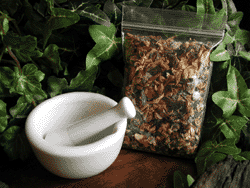
In keeping with it being the New Year and "fixing" ourselves, I thought I would write down a spell which I would be doing for myself this coming year.
I think that sometimes we forget just who and what we are. Stress, worries, rudeness and general nastiness rubs off on us each and every day and sometimes we forget to take that bit of time out to look after ourselves. I admit, it is a but of fluffiness, but the old adage is true...if you are down and out and feeling uch, and people are negative towards you, you will start feeling worse. With this, a little pick-me-up (without drug-use) things might change your outlook.
The time you take to restore yourself is precious. Perform a self-blessing every day.
Take sage and aromatic lavender and tie it in a muslin pouch. Breathe the aroma in three times. Beginning at the top of your head, the crown chakra, pass the pouch down to your feet, gently touching your other sacred chakras: throat, solar plexus, stomach, and pelvis. Then, holding the bag of herbs over your heart, speak aloud.
"Gone are sorrows, illness and woe,
Here wisdom and health begin to flow.
My heart is whole, fills my soul.
Blessed am I."
I have taken this from the Spell Deck - 36 Good Spells for Every Day - by Witch Bree (Brenda Knight) - and mean no infringement on copyright or any such slur.
Lazy

I admit to being a very bad girl and not posting here, or on my Musings website for ages. There is no excuse but laziness.
Although, to be fair, I have been spending quite a bit of time working on a story which is growing nicely (10,000 words plus = yay me!) and reading tonnes. As well as cooking, cleaning, catching up with sleep and generally having a lovely amount of down time!
It has been fantastic to just kick back over the past few weeks and relax. It is such a rushed life these days that it hardly ever happens anymore.
With the new year dawned (happy new year, btw!) it is the impetus to work more on the site. Maybe give it a new look for the new year...I will see what I can find. Maybe not one of my own designs, but another one from somewhere else.
But apart from that, more blogs about paganism here in the UK, abroad, spells, walks in the forest, countryside, general thoughts, advice - all such happy things. And, for me, on an esoteric level - my tarot and runes...I MUST do something positive about them. I have got such lovely decks that are just calling out to be used and learned. So, that is my resolution for this year - to become an adept taroist and a helrunar - lots of hard work, but who knows where it might lead!
Saturday, December 17, 2005
Yule tidings!

In ancient days the folk of old
When chilled with fright by winter's cold
Did kindle up a great Yule fire
With leaping flames in its great pyre;
So to entice the waning sun
So to entice the waning sun
To rise again and wider run;
It's fiery course across the sky,
To warm them so they would not die.
So we, whose minds now sense a chill
So we, whose minds now sense a chill
Of anger in the evil will,
The human conflict, hate, and strife,
Which hold a menace over life;
Would kindle up a flame of love
Would kindle up a flame of love
That we within our hearts may move,
In Yuletide joy, with love embrace
And thus abide in peace and grace.
Wednesday, November 23, 2005
Tricksey Faeries
 Loch Earn, St Fillans, Pertshire
This, also from the Times really interested me - how good that we are standing up for our heritage and beliefs, eventhough, no doubt, the city slickers think it is a "whole bunch of malarky." I would rather be on the safe side!
________________________
Fairies stop developers' bulldozers in their tracks
By Will Pavia and Chris Windle
VILLAGERS who protested that a new housing estate would “harm the fairies” living in their midst have forced a property company to scrap its building plans and start again.
Marcus Salter, head of Genesis Properties, estimates that the small colony of fairies believed to live beneath a rock in St Fillans, Perthshire, has cost him £15,000. His first notice of the residential sensibilities of the netherworld came as his diggers moved on to a site on the outskirts of the village, which crowns the easterly shore of Loch Earn.
He said: “A neighbour came over shouting, ‘Don’t move that rock. You’ll kill the fairies’.” The rock protruded from the centre of a gently shelving field, edged by the steep slopes of Dundurn mountain, where in the sixth century the Celtic missionary St Fillan set up camp and attempted to convert the Picts from the pagan darkness of superstition.
“Then we got a series of phone calls, saying we were disturbing the fairies. I thought they were joking. It didn’t go down very well,” Mr Salter said.
In fact, even as his firm attempted to work around the rock, they received complaints that the fairies would be “upset”. Mr Salter still believed he was dealing with a vocal minority, but the gears of Perthshire’s planning process were about to be clogged by something that looked suspiciously like fairy dust.
“I went to a meeting of the community council and the concerns cropped up there,” he said. The council was considering lodging a complaint with the planning authority, likely to be the kiss of death for a housing development in a national park. Jeannie Fox, council chairman, said: “I do believe in fairies but I can’t be sure that they live under that rock. I had been told that the rock had historic importance, that kings were crowned upon it.” Her main objection to moving the rock was based on the fact that it had stood on the hillside for so long: a sort of MacFeng Shui that many in the village subscribe to.
“There are a lot of superstitions going about up here and people do believe that things like standing stones and large rocks should never be moved,” she said.
Half a mile into Loch Earn is Neish Island. From there the Neish clan set forth to plunder the surrounding country, retreating each time to their island. Early in the 17th century, the MacNabs retaliated from the next valley, carrying a boat over the mountains, storming the island and slaughtering most of the Neishes.
This summer Betty Neish McInnes, the last of that line in St Fillans, went to her grave — but not before she had imparted the ancient Pict significance of the rock to many of her neighbours.
“A lot of people think the rock had some Pictish meaning,” Mrs Fox said. “It would be extremely unlucky to move it.”
Mr Salter did not just want to move the rock. He wanted to dig it up, cart it to the roadside and brand it with the name of his new neighbourhood.
The Planning Inspectorate has no specific guidelines on fairies but a spokesman said: “Planning guidance states that local customs and beliefs must be taken into account when a developer applies for planning permission.” Mr Salter said: “We had to redesign the entire thing from scratch.”
The new estate will now centre on a small park, in the middle of which stands a curious rock. Work begins next month, if the fairies allow.
Pagan beliefs in Mexico and Guatemala

I saw this article in the T2 Times supplement and thankfully, they had a link online. It appeared on 17th November 2005.
_______________________
Times2The pagan beliefs that enrich Mexico and Guatemala
Mary Ann Sieghart
Dateline: Oaxaca
It was supposed to be the Day of the Dead, but it turned out to be the Nearly-All-Week of the Dead. Long before real Hallowe’en, Oaxaca’s balconies were draped with life-size skeletons in crazy poses. Even a bench sported a couple of skeletons in conversation, the white one with a moustache tenderly putting his arm round the pink one.
They do death differently in Mexico.
And what a way to do it! Market stalls are piled high with skulls, some made of sugar with brightly coloured icing for eyebrows, others coated in sesame seeds with misshapen peanuts for teeth.
On October 31, the serious celebrations begin with a Day of the Dead breakfast: hot chocolate, sweet bread, and a banana-leaf-wrapped parcel containing chicken in a spicy chocolate sauce. By 10pm we, along with most of Oaxaca, are at the main cemetery, some four miles out of town. There, stilt-walkers arrive in garish costumes, having tottered all the way from the centre. Outside the cemetery, the atmosphere is redolent of an August bank-holiday fair: packed with crowds, the street contains fairground rides and cheap stalls with tacky plastic prizes.
Inside is weirder still. The walls are honeycombed with tombs, a lighted candle in each recess. The graves are decorated with marigolds, lilies and candles. In the far corner is a stage from which a torch singer, dressed in Morticia Addams make-up and ghostly robe, belts out a cabaret number. Then a troupe of actors dressed as angels performs a slapstick comedy, hitting each other over the head with balloons.
It is as if you can feel the pagan Mexico thrusting its way up through the crust of Catholicism.
You sense this most powerfully in the indigenous Indian communities. We move on to the cemetery in Xoxocotlan, an outlying Indian village. There the ground is bright orange, even in the middle of the night, for the carpet of marigolds, spiked by beer and Coke bottles, is so brightly lit by candles. Around each intricately decorated grave sit the relatives of the dead person, eating, drinking and chatting for all the world as if this were a normal family picnic.
There’s a carnival feel to the way the Mexicans approach death, a sense of delicious expectation that the spirits of your loved ones will return to visit you if you tempt them with an offering of their favourite tipple. The atmosphere is not grave at all. For, if you believe that your ancestors are present in your everyday life, why should you be gloomy in remembrance of them?
The Mayan Indians, who predominate in Mexico’s Chiapas and Guatemala, are highly spiritual and nominally Catholic, for the Spanish conquistadors imposed their religion on the indigenous people just as they imposed everything else. Every cemetery is a thicket of crosses; every village contains a church. The casual eye might mistake this for Catholic piety. But the Maya, who craft colourful masks to sell at market, have turned Catholicism into a mask of its own. From the outside, each church looks like a standard Spanish place of worship. Go inside, though, and you often discover that it is being used instead as a Mayan temple.
In the church of Chamula, up in the mountains of Chiapas, the pews and altar have gone and the floor is carpeted with pine needles. Candles burn all over the floor. Dotted about are families who have paid a shaman to cure them. He feels the ill person’s pulse and then conducts the appropriate ritual: passing eggs in a pattern over their body, sacrificing a chicken and then spitting firewater or Coke over the dead bird, chanting prayers and lighting coloured candles.
The sight is as pagan as it is heartening. After more than 300 years of oppression at the hands of Christians, these people have co-opted the religion and reclaimed it for themselves. The churches have no priests and conduct no services. The Indians don’t read the Bible. The Vatican has sundered relations with them. But they are still deeply religious people. For them, Jesus is the God of the Sun, and Mary of the Moon. The saints represent more minor Mayan gods.
The Mayas’ main worry is that modern evangelism is trying to replicate the conquest that Catholicism attempted in the 17th century. Evangelical missionaries are gaining hold in Mayan villages, and demanding that converts relinquish their traditional beliefs.
It would be a tragedy if they succeeded. These indigenous people have fought so hard for so long not to join the Western world. As we saw on the Day of the Dead, Mexico and Guatemala are enriched, not impoverished, by their pagan beliefs. If the brutal Spanish conquerors failed to extinguish these noble people, surely the modern world should be broadminded enough to allow them their difference. You can’t help thinking: why can’t the Church just leave these people in peace?
Dig this buried treasure...
When I spoke of paganism lying just below the surface in Mexico, I wasn’t aware of how literally this was true — until we took a bus journey to the Guatemalan border. On our right lay a spine of absurdly conical foothills, like the overlapping triangular mountains you see on the horizon in children’s drawings. Closer up were smaller hillocks, also surprisingly symmetrical. One was not even triangular, but trapezoid, with sloping shoulders and a flat top.
The bus driver gestured casually in their direction. “That’s an archeological site,” he told us. The triangular hillocks, it turned out, were actually Mayan Mayan pyramid temples, overgrown with grass and trees. Talk about buried treasure. What a shame the Mexicans can’t afford to excavate it.
Thursday, November 17, 2005
Sonnet of the Moon

Sonnet of the Moon
by Charles Best, 1608
Look how the pale Queen of the silent night
doth cause the ocean to attend upon her,
and he, as long as she is in sight,
with his full tide is ready here to honor;
But when the silver waggon of the Moon
is mounted up so high he cannot follow,
the sea calls home his crystal waves to morn,
and with low ebb doth manifest his sorrow.
So you that are sovereign of my heart
have all my joys attending on your will,
when you return, their tide my heart doth fill.
So as you come and as you depart,
joys ebb and flow within my tender heart.
Saturday, November 12, 2005
Yet another look!

I felt creative today and created another look for the website, probably more in keeping with its The Old Ways title.
Do let me know if you approve - I have redone the links and the archives work - yippee! - so, all in all it should be fine.
Subscribe to:
Posts (Atom)