Monday, April 17, 2006

Religious Intollerance


I have given myself a few days to calm down after receiving an email from a family member. Fortunately, not blood family, but an add-on. If it were blood family, I don’t know what I would have done. As it is I hardly have any contact with “it” anyway and from now I definitely won’t want anything to do with them as they have just proved to me that narrow mindedness is catching.

The email in question started off innocently enough, telling me what they were up to for the Easter weekend. And then, unexpectedly, the following was inserted into the email:

to day until 2 morrow we fast for our heathen foreign families praying they dont die and burn in hell ........ then have communion and chomp a few hot - x - buns to break the fast after the easter service.

And I think to myself – in the words of Marcus – WTF? Where in all the world did that comment come from? What prompted it at all? Did add-on family member and its wife eventually lose their minds and join a cult of some sort? Never in my wildest dreams have I ever said anything about their religion, about my own beliefs, or anything of the sort...

I think they must have because I have NEVER in my life had anyone, even jocular, say anything to me like that. My outrage is genuinely beyond words. What makes me shake my head is that they are Rice Christians – do you know what Rice Christians are? – they “converted” to Christianity to have a white church wedding a few years ago.

At first it was jocular and then in the end, all the dogma sank in. We thought, fantastic, good for them. Fabulous thing to do, get religion, some direction. They have been after all, been living in “sin” and suddenly, once they got engaged and went to church, oops, no sex, sorry. Only for married people. They got married in a hair raising “halleluja” service. She looked lovely in her dress though. And the food was nice. She did swear like a trooper at the party and danced like a mynead. He just leered all the girls and regretted his choice of getting hitched.

Then, they started going to church, for real. Then of course they started on us. Come to church, blah blah. We never took them up on any of their offers. I grew up in a highly Christian household and after 24 years of going to church 3 times a week, teaching Sunday School and singing in the choir, and belonging and running the church youth group, I have had enough. I now believe what I believe, I am a searcher and have read tonnes of books on theology, mysticism, gnostic gospels and everything else I could lay my hands on as I was trying to find something that resonated better than an angry god that hated women, that encouraged bloodshed and did nothing to stop the wars raging across the world. I can form my own opinions now, thank you very much, I don’t need some pretend-priest of some scattered branch of some obscure fragment of a denomination to preach at me and tell me if I don’t repent, I will burn in hell, that as a woman I am worth less than a man and that all we are good for is to support our “men” and be good wives, tending to our many children as birth control is a sin.

And now this email! After a few other veiled comments like this: “maybe you should go to church sometimes, pray for your souls”, I think, said add-on family member can go and fly a kite in a thunderstorm. And the funniest thing is, sober they are religious and don’t swear and behave relatively normally (and listen to nice church approved music) but give them a drink and by the gods, they are back to their old ways, as easy as that, drinking, swearing and smoking and carousing. Rice Christians, they are a funny lot. I am so glad I haven't seen them in almost five years. I don't think I would be able to control myself if I ever had to see them again.

Triskelion Spell - To Protect a Traveller


This spell is to protect you on your travels.

Background:

The word "triskelion" comes from the Greek language and means "three legged". It is a very old symbol that has been ascribed many meanings through the ages and that is inevitably bound up with the mysterious nature of triplicities.

How to cast the spell:

One pale blue candle, 15 - 20 cm in length

Matches/lighter

One small single scallop shell, drilled

One fine paintbrush

One tube of vermillion paint

One length of 60cm cord

Timing - cast on a waxing moon and on a Sunday, sacred to the sun.

Casting the spell:

  • Cast a circle
  • Light the candle saying:

"Hermes of the skies

Hermes the traveller

Look well upon (insert name)

That they are hale going out

And hale coming in."

  • Paint on the inside of the scallop shell the outline of a triskelion.
  • Sit in the centre of the circle with the upturned shell in your upturned right palm, which should be placed over your upturned left palm. Close your eyes and visualise the triskelion you have painted spinning clockwise, faster and faster until it is a blur.
  • When you are ready, blow onto the shell with your breath to bless it with power of air. When the paint dries, threat it with the chord and dip it into natural saltwater at the earliest opportunity.
  • The triskelion pendant should be worn around the neck of those who would call on its protective powers.

Monday, April 03, 2006

Witchy Con in retrospect...

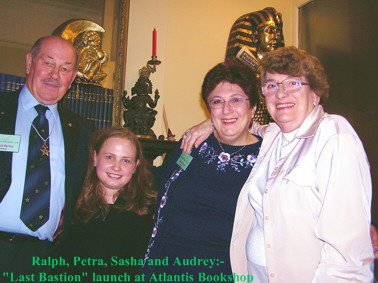
Ralph on the far left with Audrey on the far right


Hello fellow crafters

This Saturday past - 1st April - saw the second Witchy Con take place at Wantage in Oxfordshire.

We arrived early enough, got parking and made our way to the Civic Hall where we were met by smiling faces and a very calm Judith of New Moon. We registered, got our name badges and our familiars badges and after pausing at the raffles table to admire all the very pretty prizes, we went upstairs for the opening ceremony. Judith is fantastic as a spokes person. She is funny and warm and had everyone smiling as she invited everyone to shop till they dropped and to attend as many of the talks and workshops as they could.

The whole day went well - she cleverly scheduled a lunch break for everyone and no workshops or talks were held during this time. All of the workshops and talks were free, included in the price of £10, which was a bargain.

Marcus and I attended the first talk of the morning by Sally Morningstar on Wiccan Healing. It was a very solemn talk and I genuinely took some new notions away with me. We wandered away to the dealers room, did a quick scout around and I bought two lovely bracelets - one depicting the 22 major arcana tarot cards and the other a sort of a charm bracelet. There weren't many traders in the hall, but they had good quality goodies and of a varied hue, so that really made a good impression. I shot off to listen to the Ralph Harvey talk whilst Marcus scooted off to take some photos of the Tarot workshop.

Wow - Ralph Harvey is such a genuinely knowledgeable gentleman with a keen sense of humour. And the amount of knowledge he has to draw from 52 years in the craft and with his wife and partner, Audrey they have seen so much and have been the catalysts in the world of the Craft for such a long time, that it was a genuine treat to listen to him. He talked lovingly about his history and told interesting antecdotes of his research. He is the author of a book called The Last Bastion - it explores the history of Witchcraft in England and especially in Sussex - the last county in England to embrace Christianity and the first to re-embrace Witchcraft once the Witchcraft Act was repealed in 1951.

We broke for lunch, came back and I sat in on John Dee's talk on Egyptology. A huge, vast and very interesting subject to cover in an hour. He did his best though and had us lapping it up - his style was humourous and jocular but informative. Yet another person to corner in a pub to sit down and talk to for hours.


John Dee


Afterwards I had the good fortune to sit down and chat with Ralph Harvey and his wife and I must say that they were wonderful. Marcus joined me and we sat, like days of old, before our elders, listening to tales told and of their adventures. I asked Ralph if he would ever consider writing his autobiography and he said no, quite vehemently. He went on to explain that so many things have happened in his life, personal and career wise that most people will expect it to be untrue. He launched into a story that had us gasping with laughter, it was so preposterous, yet true, by all accounts as Audrey backed him up on it. We could see that they were a dynamic couple, having got that intrinsic link that true soul partners have, finishing each other's sentences etc. We must have chatted in excess of forty minutes or so and both Marcus and I came away feeling like we have spent time with two very genuine and lovely people. They invited us to stay in touch - something which I think we will do.

Marcus flitted about, in a manly way, posing people for photographs and general making everyone touch up their make-up. I sat in on part of the Anna Franklin talk and too soon the day was over, with Judith closing the day down. Then the real fun started - the raffle! We all crowded around, around 200 of us, waiting to see if we had won anything. Sadly, my strip I bought came nowhere. However, they did a further draw based on our pre-registered badge numbers and I won! I darted forward and chose a Ly de Angelis book called The Quickening. Exciting stuff! We did a last zoom around the traders hall, waved goodbye to Judith and her team and drove home.

It was a good day. It was well attended, but there is scope for more people to attend. The talks I attended were brilliant and I enjoyed them thoroughly. I will definitely be going again next year.

List of traders attending: http://www.witchycon.co.uk/dealers.htm

Thursday, March 16, 2006

Some bragging rights...

Dear friends and visitors

I was struck by the high volume of visits the site has recently had so I did some investigation (because I am vein) and discovered that if you typed in some phrases like Witchy Con (and some others, but since WC is close to our hearts, we'll stick with that example) on Google...well, by Odin's Thunderbolt....our smidge of a website comes up! How unutterably cool and wildly exciting is that!

I thought that it would be really excellent to celebrate that with a recipe for some divine ginger nut and chocolate chip cookies!

Ingredients


2 oz (50 g) dark chocolate (75% cocoa solids), chopped into little chunks

1 slightly rounded teaspoon ground ginger

4 oz (110 g) self-raising flour

½ oz (10 g) cocoa

1 level teaspoon bicarbonate of soda

2 oz (50 g) butter, cut into cubes

1½ oz (40 g) golden granulated sugar

2 oz (50 g) golden syrup (about 2 tablespoons)


Pre-heat the oven to gas mark 4, 350°F (180°C).


You will also need a 11 x 16 inch (28 x 40 cm) baking tray lined with baking parchment.

Begin this by sifting the self-raising flour, cocoa, ginger and bicarbonate of soda into a mixing bowl. Then, using your fingertips, rub in the butter until the mixture resembles breadcrumbs and next stir in the sugar and chopped chocolate. Now add the golden syrup, then mix everything with a wooden spoon and finish off by squeezing the mixture together with your hands.

After that, divide the mixture into 16, and roll each portion into a ball. Place on the lined baking sheet, very well spaced out as they will spread out quite a bit during cooking, flatten each one slightly, then bake on the centre shelf for 15-20 minutes, or until they have spread out and turned cracked and craggy. Cool on the baking tray for a few minutes then, using a palette knife, remove to a wire rack to cool completely.


Wednesday, February 22, 2006

Witchy Con

I am happy and proud to announce that hubby and I will be going to Witchy Con this year. It is only in its second year (I think) but is becoming more popular. It is being held in Wantage and the price for entry is £10 - and this will get you free coffee and tea during the day, free entrance to all workshops and talks and that leaves you extra money to spend on the trading hall. You also get a goodie bag with magazines, book chapters and who knows what else she can rustle up!?

Witchy Con is the brainchild of Judith Lewis ... oh blah, let me just copy and paste the blurb from her website:

WitchyCon is the brainchild of Judith Lewis, a lightly seasoned conrunner (even better in a white wine sauce) and David Row, an overseasoned conrunner. Both have extensive experience creating and running a variety of conventions across different subject matters close to their heart. Having already worked on or with Fantasy, Science Fiction and Anima conventions, one interest was left unconventioned - Paganism, Witchcraft and Magick.

Having experienced a variety of conferences and constantly muttered about how they should have been done differently, the pair have put their money where their mouthes are (and feet and copious amounts of Malteesers) and organized WitchyCon. This convention brings to the pagan market all the things each liked from their respective conrunning experiences.

WitchyCon is meant to be an experience. You do not need to know a single thing about paganism or anything witchy as the whole purpose is to educate in a fun way. Each talk touches upon a different aspect from the world of paganism and presents a great opportunity to learn without needing to know anything before hand. New friends are made, old ones revisited and fun is the theme of the day.

Belated Imbolc Post

I must admit to being a lazy mare.

I was so wrapped up in my own things (planning my birthday) at the beginning of February that the Imbolc celebration flew by and I had not given it any thought.

So I thought that I would make up for it quickly before its time to actually post about the Spring Equinox in March!
***

Imbolc (pronounced 'im'olk' also known as Oimelc) comes from an Irish word that was originally thought to mean 'in the belly' although many people translate it as 'ewe's milk' (oi-melc).

Imbolc was one of the cornerstones of the Celtic calendar. For them the success of the new farming season was of great importance. As winter stores of food were getting low Imbolc rituals were performed to harness divine energy that would ensure a steady supply of food until the harvest six months later.Like many Celtic festivals, the Imbolc celebrations centred around the lighting of fires.

Fire was perhaps more important for this festival than others as it was also the holy day of Brigid (also known as Bride, Brigit, Brid), the Goddess of fire, healing and fertility. The lighting of fires celebrated the increasing power of the Sun over the coming months. For the Christian calendar, this holiday was reformed and renamed 'Candlemas' when candles are lit to remember the purification of the Virgin Mary.

Imbolc is still a special time for Pagans. As people who are deeply aware of what is going on in the natural world they recognise that there is strength in cold as well as heat, death as well as life. The Horned God reigns over the Autumn and Winter and and although the light and warmth of the world my be weak he is still in his power. Many feel that human actions are best when they reflect the actions of nature, so as the world slowly springs back into action it is time for the small tasks that are neglected through the busy year. Rituals and activities might include the making of candles, planting spring flowers, reading poetry and telling stories.

***

I must say that reading the last sentence : Rituals and activities might include the making of candles, planting spring flowers, reading poetry and telling stories : has really made me feel tonnes better. That is exactly what I have been doing, besides neglecting my poor witchy site so badly. Writing or rather, telling stories. I am rubbish at writing poetry but reading it is something that I love - hence the random pieces that I post now and again.

So, in theory, eventhough I didn't really do anything consciously for Imbolc I was there, doing my story telling. Now, all I have to do is pay attention to the upcoming celebrations for the rest of the year!

Tuesday, February 14, 2006

THE SPIRIT GUIDE


Thou Spirit of Wisdom who guides me,
From out of the Shining World to attend me,
The shepherding kind of the fold of faerie kin
To make round about me this night;

Drive from me every ill-will and danger,
Surround me on the sea of the unholy,
And in the narrows, crooks, and straits,
Keep thou my coracle, keep it always.

Be thou a bright flame before me,
Be thou a guiding star above me,
Be thou a smooth path beneath me,
Be thou a kindly wind behind me,
Today, tonight, and for ever.

And when I grow weary and I become
A stranger in this land,
Lead me to the Land of Promise;
For it is time for me to go home .

Saturday, January 28, 2006

Landmark and sacred trees


I was looking through all the things I had on my hard drive and found this and thought it might make an interesting read for all my visitors interested in all things green and beautiful.

Landmark and sacred trees of Leicestershire and Rutland
Penny Drayton

Almost universally trees have been venerated and believed to be the dwellings of Tree Spirits, sometimes called Dryads. Deliberately planted groves of sacred trees, such as oak, elder, ash, rowan and hawthorn, were probably the earliest man-made sacred sites. Greek and Roman temples with their columns and decorated capitals may be thought of as an architectural continuation of such groves. Tacitus described the sacred groves in Germany during the Roman period. Closer to home, the importance of tree mythology to the ancient Celts is well-known, in part through Robert Graves' imaginative reconstruction in The White Goddess which explores in detail the tree alphabets and related lore [1].

As late as the eleventh century Cnut was proclaiming laws which prohibited people from owning land which was a sanctuary centred on a tree. St Boniface cursed an oak dedicated to Thunor yet the Old Norse place-name element lundr (meaning '(?sacred) grove' but usually corrupted to 'land' in modern spellings) remains common in England as well as Scandinavia. Many hundred moot places have names ending in '-tree', often prefixed by a personal name, and such names may relate back to the ancient sanctuaries around sacred trees; examples from Leicestershire are given below.

Predictably no trees have survived from pre-christian times and even the Gospel Oaks, where the early missionaries preached, have all gone. The surprisingly abundant evidence for sacred trees comes mostly from place names and folklore as this article will attempt to show, even though it is based only on my researches in Leicestershire and Rutland.

It is worth noting that in Leicestershire the characteristic hedgerow tree is the ash. Oaks and elms have always been less abundant than in most other parts of England. It is difficult to explain this; it may be because the soil conditions were favourable to this species, although there are no surviving woodlands where ash is the predominant species. This part of England was probably largely de-forested before the Roman invasion and all trees and woodland can be regarded as managed rather than natural. Hedgerow trees in particular are usually deliberated planted, or at least deliberately allowed to grow by the hedge trimmer.

Ash makes strong, light timber and excellent fire wood and was no doubt considered a valued species. But could there be deeper reasons for its popularity? It is clear that the ash was sacred to our forefathers - Pliny wrote of their power as protection against snakes and even the shadow cast by an ash was said to be avoided by snakes. The Belgic bronze age invaders apparently worshipped the ash, under the name Gwydion. The Saxons and Danes held ash trees in especial esteem, as Yggdrasill, the Sacred World Tree, was usually described as an ash. Ash is still the favourite wood for walking sticks, a reminder of the tree's power as a sacred ashen spear. Ash was also a favourite herding stick and the proper wood for making shepherds' crooks. A bunch of ash keys was considered a powerful guard against witchcraft.

Whether or not ancient inhabitants of this county encouraged the ash for practical or propitious reasons, they certainly had at least one Great Sacred Grove on the edge of the county. Vernemetum was a Roman town which stood at the crossroads of the Fosse Way and an ancient Salt Way (129:648249) and its name means 'Great (or Especially) Sacred Grove'. This suggests that the site was sacred in late iron age times, presumably being a Druidic grove. Although little archaeological investigation has taken place and nothing is known of its role in the Roman period the site was still important in the later Saxon period as the eighteenth century antiquarian, Stukely, refers to a legend of the ruins of a Saxon church standing in a place known as The Wells. Recent finds by metal detector users seem to confirm the site. On the ridge of the hill, at the crossroads itself, several Saxon barrows were excavated in the 1960s, although the excavation reports have not so far been published.

Moots at trees

As has already been suggested, ancient moot sites may be the last vestiges of ancient sacred enclosures based on tree worship. Towards the south of the county the now-obsolete administrative area of the Gartree Hundred derived its name from geirtre which means 'a tree with an overgrown gash or goitre' - a useful landmark for a moot place. Indeed, throughout Britain '-tree' is a very common part of Hundred names and Leicestershire is certainly no exception. The meeting place of the Sparkenhoe Hundred was probably at Shericles Farm near Desford (140:467026), which derives from scirac meaning "the hundred oak". Another moot took place in Oadby at a place called Spelthorn - 'a thorn where speeches are made'. Framland Hundred derives from 'Faena's grove', which is almost certainly the wood still surviving north of Melton Mowbray at 129:747224. The earlier interpretation of lundr as 'sacred grove' has recently been dismissed by Margaret Gelling, a notable expert on place-names, who interprets the word as simply 'small wood'. Another example of lundr in Leicestershire is Swithland (129:5412); Gelling attributes this to 'burnt-clearing wood' [2].

The meeting place of the Gartree Hundred was well-known as late as the end of the eighteenth century when Nichols described the 'Gartree Bush' in detail. It was situated just to the north of the Roman Road known as Gartree Road and west of the ancient ridgeway running north-south (141:716974)
There is a second Gartree name in Leicestershire, Gartree Hill south of Melton Mowbray (129:760145). Presumably this too was marked by a 'goitred' tree which once had particular significance as a landmark - the hill forms part of the ancient trackway running directly north-south between the hill fort at Burrough on the Hill (761120) and Melton Mowbray.

Oaks

The splendidly suggestive village name of 'Holy Oaks' relates to a now-deserted village south of Stockerston (141:845956). Nothing is known of the origins of this place-name.
Three Shire Oak marked the boundary of Leicestershire, Lincolnshire and Nottinghamshire (130:822429). On earlier maps it is shown as 'Three Shire Bush'. Originally there was also a standing stone here, called the 'Star Stone' which was reputed to have fallen from the sky.
Copt Oak in Charnwood takes its name from a pollarded oak which stood until 1855 in the corner of the churchyard (129:483128). It was said to be two thousand years old. Certainly it was the meeting place for the old forest swanimotes and later was a Civil War rallying point. The church and churchyard are merely nineteenth century intrusions on the site.

White's Directory for 1864 said it was fashioned in the form of a 'Tau' by careful removal of all branches except two. The trunk was said to be 20 feet tall and more than 21 feet in circumference. However an early nineteenth century illustration in Nichols shows only a hollow trunk with small branches growing out of it in a natural manner.
There was at least one other Copt Oak in the county. There is a farm of this name near to Narborough (140:531978).
Abbot's Oak is the name of what is know a farm to the north of Bardon Hill (129:463143) and just up the road from Copt Oak in Charnwood.

In the churchyard of St Peter's, Belgrave (140:5907) was an extremely ancient oak called 'Main Oak'. The churchyard is also reputed to be haunted by a white lady.

When the so-called "nine day's queen", Lady Jane Grey (who actually reigned for thirteen days), was beheaded the oaks at her home in Bradgate Park (129:5311) were reputedly pollarded as a sign of mourning.
An oak was planted in front of the rectory in Burton Overy (141:6798) at the Restoration from an acorn of the famous Boscabel oak. A near neighbour was grown from its acorn on the Diamond Jubilee of Victoria; today only this tree survives.

A so-called Domesday Oak stands near Rutland Water at Edith Weston (141:9205). (Also nearby, at Normanton Park Hotel, is one of Britain's oldest cedar trees.)

Other trees

Between Holywell Haw and Nanpantan to the west of Loughborough there used to stand a 'sweating tree'. It was also distinctive because it blossomed twice a year, in spring and autumn.
An ancient hollow elm used to stand in the churchyard at Sileby (129:600152) from under which the vicar is said to have distributed oranges to children on Whit Monday [5]. Interestingly, the eighteenth century engraving in Nichols does not show such a tree; there is no such tree today.
On a map of 1777 a crossroads in the west of the county is shown as 'Hoo Ash'; this is now the centre of Coalville (129:429141) [4].

References
1: R. Graves, The white goddess, Faber, 1961. 2: M. Gelling, Place-names in the landscape, Dent, 1984. 3: P. Devereux, 'The forgotten heart of Albion, pt1' in The Ley Hunter, No.66, pp9-12, 1975. 4: J.D. Welding (ed.), Leicestershire in 1777, Leicestershire Libraries and Information, 1984. 5: R. Palmer, The folklore of Leicestershire and Rutland, Sycamore Press, 1985.
Originally published in Mercian Mysteries No.9 November 1991.
(image placeholder)

At the Edge home page
http://www.indigogroup.co.uk/edge/

Copyright 1991, 1996, 2001. No unauthorised copying or reproduction except if all following conditions apply: a: Copy is complete (including this copyright statement). b: No changes are made. c: No charge is made.
At the Edge / Bob Trubshaw / bobtrubs@indigogroup.co.uk Created April 1996; updated May 1998

Monday, January 02, 2006

A Litany, a mantra, a plea


We stand in your place, Ancestors
We perform your deeds, Ancestors
Do not forget, do not forget,
Let it be these words, Holy Ones,
that my heart sings in my chest.
Do not forget, do not forget,
to walk in the sacred way.
Do not forget, do not forget,
that all I see is sacred.
Do not forget, do not forget,
my sacred duty to the world which surrounds me
Do not forget, do not forget.
Grant me this gift, you whom I worship,
not to forget.

Sacred Texts


The website Sacred Texts (link added above) is one of the most valuable tools for those searching out ancient (and recent) knowledge on practically all things. Like the Gutenberg Project they work hard at translating and transcribing ancient texts for public perusal on the Internet. They also sell their handiwork in the form of a CD but unfortunately I am cash poor and can't afford one but have decided to plug them on here instead as I visit the website often enough.

In their own words: This is a quiet place in cyberspaced evoted to religious tolerance and scholarship.

They have articles and translations on subjects as diverse as Atlantis, Buddhism, I Ching, Prophecy, Shamanism, Shinto, Taoism, Thelema and they carry a whole swathe of articles and books on Legends and Sagas of the ancient world. A fantastic website.

I would recommend it to all searchers of knowledge.

Sunday, January 01, 2006

Self-Blessing


In keeping with it being the New Year and "fixing" ourselves, I thought I would write down a spell which I would be doing for myself this coming year.

I think that sometimes we forget just who and what we are. Stress, worries, rudeness and general nastiness rubs off on us each and every day and sometimes we forget to take that bit of time out to look after ourselves. I admit, it is a but of fluffiness, but the old adage is true...if you are down and out and feeling uch, and people are negative towards you, you will start feeling worse. With this, a little pick-me-up (without drug-use) things might change your outlook.

The time you take to restore yourself is precious. Perform a self-blessing every day.

Take sage and aromatic lavender and tie it in a muslin pouch. Breathe the aroma in three times. Beginning at the top of your head, the crown chakra, pass the pouch down to your feet, gently touching your other sacred chakras: throat, solar plexus, stomach, and pelvis. Then, holding the bag of herbs over your heart, speak aloud.

"Gone are sorrows, illness and woe,
Here wisdom and health begin to flow.
My heart is whole, fills my soul.
Blessed am I."

I have taken this from the Spell Deck - 36 Good Spells for Every Day - by Witch Bree (Brenda Knight) - and mean no infringement on copyright or any such slur.

Lazy


I admit to being a very bad girl and not posting here, or on my Musings website for ages. There is no excuse but laziness.

Although, to be fair, I have been spending quite a bit of time working on a story which is growing nicely (10,000 words plus = yay me!) and reading tonnes. As well as cooking, cleaning, catching up with sleep and generally having a lovely amount of down time!

It has been fantastic to just kick back over the past few weeks and relax. It is such a rushed life these days that it hardly ever happens anymore.

With the new year dawned (happy new year, btw!) it is the impetus to work more on the site. Maybe give it a new look for the new year...I will see what I can find. Maybe not one of my own designs, but another one from somewhere else.

But apart from that, more blogs about paganism here in the UK, abroad, spells, walks in the forest, countryside, general thoughts, advice - all such happy things. And, for me, on an esoteric level - my tarot and runes...I MUST do something positive about them. I have got such lovely decks that are just calling out to be used and learned. So, that is my resolution for this year - to become an adept taroist and a helrunar - lots of hard work, but who knows where it might lead!

Saturday, December 17, 2005

Yule tidings!


In ancient days the folk of old
When chilled with fright by winter's cold
Did kindle up a great Yule fire
With leaping flames in its great pyre;
So to entice the waning sun
To rise again and wider run;
It's fiery course across the sky,
To warm them so they would not die.
So we, whose minds now sense a chill
Of anger in the evil will,
The human conflict, hate, and strife,
Which hold a menace over life;
Would kindle up a flame of love
That we within our hearts may move,
In Yuletide joy, with love embrace
And thus abide in peace and grace.

Wednesday, November 23, 2005

Tricksey Faeries

Loch Earn, St Fillans, Pertshire

This, also from the Times really interested me - how good that we are standing up for our heritage and beliefs, eventhough, no doubt, the city slickers think it is a "whole bunch of malarky." I would rather be on the safe side!

________________________


Fairies stop developers' bulldozers in their tracks
By Will Pavia and Chris Windle

VILLAGERS who protested that a new housing estate would “harm the fairies” living in their midst have forced a property company to scrap its building plans and start again.

Marcus Salter, head of Genesis Properties, estimates that the small colony of fairies believed to live beneath a rock in St Fillans, Perthshire, has cost him £15,000. His first notice of the residential sensibilities of the netherworld came as his diggers moved on to a site on the outskirts of the village, which crowns the easterly shore of Loch Earn.

He said: “A neighbour came over shouting, ‘Don’t move that rock. You’ll kill the fairies’.” The rock protruded from the centre of a gently shelving field, edged by the steep slopes of Dundurn mountain, where in the sixth century the Celtic missionary St Fillan set up camp and attempted to convert the Picts from the pagan darkness of superstition.

“Then we got a series of phone calls, saying we were disturbing the fairies. I thought they were joking. It didn’t go down very well,” Mr Salter said.

In fact, even as his firm attempted to work around the rock, they received complaints that the fairies would be “upset”. Mr Salter still believed he was dealing with a vocal minority, but the gears of Perthshire’s planning process were about to be clogged by something that looked suspiciously like fairy dust.

“I went to a meeting of the community council and the concerns cropped up there,” he said. The council was considering lodging a complaint with the planning authority, likely to be the kiss of death for a housing development in a national park. Jeannie Fox, council chairman, said: “I do believe in fairies but I can’t be sure that they live under that rock. I had been told that the rock had historic importance, that kings were crowned upon it.” Her main objection to moving the rock was based on the fact that it had stood on the hillside for so long: a sort of MacFeng Shui that many in the village subscribe to.

“There are a lot of superstitions going about up here and people do believe that things like standing stones and large rocks should never be moved,” she said.

Half a mile into Loch Earn is Neish Island. From there the Neish clan set forth to plunder the surrounding country, retreating each time to their island. Early in the 17th century, the MacNabs retaliated from the next valley, carrying a boat over the mountains, storming the island and slaughtering most of the Neishes.

This summer Betty Neish McInnes, the last of that line in St Fillans, went to her grave — but not before she had imparted the ancient Pict significance of the rock to many of her neighbours.
“A lot of people think the rock had some Pictish meaning,” Mrs Fox said. “It would be extremely unlucky to move it.”

Mr Salter did not just want to move the rock. He wanted to dig it up, cart it to the roadside and brand it with the name of his new neighbourhood.

The Planning Inspectorate has no specific guidelines on fairies but a spokesman said: “Planning guidance states that local customs and beliefs must be taken into account when a developer applies for planning permission.” Mr Salter said: “We had to redesign the entire thing from scratch.”

The new estate will now centre on a small park, in the middle of which stands a curious rock. Work begins next month, if the fairies allow.

Pagan beliefs in Mexico and Guatemala


I saw this article in the T2 Times supplement and thankfully, they had a link online. It appeared on 17th November 2005.
_______________________

Times2The pagan beliefs that enrich Mexico and Guatemala
Mary Ann Sieghart
Dateline: Oaxaca

It was supposed to be the Day of the Dead, but it turned out to be the Nearly-All-Week of the Dead. Long before real Hallowe’en, Oaxaca’s balconies were draped with life-size skeletons in crazy poses. Even a bench sported a couple of skeletons in conversation, the white one with a moustache tenderly putting his arm round the pink one.

They do death differently in Mexico.

And what a way to do it! Market stalls are piled high with skulls, some made of sugar with brightly coloured icing for eyebrows, others coated in sesame seeds with misshapen peanuts for teeth.

On October 31, the serious celebrations begin with a Day of the Dead breakfast: hot chocolate, sweet bread, and a banana-leaf-wrapped parcel containing chicken in a spicy chocolate sauce. By 10pm we, along with most of Oaxaca, are at the main cemetery, some four miles out of town. There, stilt-walkers arrive in garish costumes, having tottered all the way from the centre. Outside the cemetery, the atmosphere is redolent of an August bank-holiday fair: packed with crowds, the street contains fairground rides and cheap stalls with tacky plastic prizes.

Inside is weirder still. The walls are honeycombed with tombs, a lighted candle in each recess. The graves are decorated with marigolds, lilies and candles. In the far corner is a stage from which a torch singer, dressed in Morticia Addams make-up and ghostly robe, belts out a cabaret number. Then a troupe of actors dressed as angels performs a slapstick comedy, hitting each other over the head with balloons.

It is as if you can feel the pagan Mexico thrusting its way up through the crust of Catholicism.

You sense this most powerfully in the indigenous Indian communities. We move on to the cemetery in Xoxocotlan, an outlying Indian village. There the ground is bright orange, even in the middle of the night, for the carpet of marigolds, spiked by beer and Coke bottles, is so brightly lit by candles. Around each intricately decorated grave sit the relatives of the dead person, eating, drinking and chatting for all the world as if this were a normal family picnic.

There’s a carnival feel to the way the Mexicans approach death, a sense of delicious expectation that the spirits of your loved ones will return to visit you if you tempt them with an offering of their favourite tipple. The atmosphere is not grave at all. For, if you believe that your ancestors are present in your everyday life, why should you be gloomy in remembrance of them?

The Mayan Indians, who predominate in Mexico’s Chiapas and Guatemala, are highly spiritual and nominally Catholic, for the Spanish conquistadors imposed their religion on the indigenous people just as they imposed everything else. Every cemetery is a thicket of crosses; every village contains a church. The casual eye might mistake this for Catholic piety. But the Maya, who craft colourful masks to sell at market, have turned Catholicism into a mask of its own. From the outside, each church looks like a standard Spanish place of worship. Go inside, though, and you often discover that it is being used instead as a Mayan temple.

In the church of Chamula, up in the mountains of Chiapas, the pews and altar have gone and the floor is carpeted with pine needles. Candles burn all over the floor. Dotted about are families who have paid a shaman to cure them. He feels the ill person’s pulse and then conducts the appropriate ritual: passing eggs in a pattern over their body, sacrificing a chicken and then spitting firewater or Coke over the dead bird, chanting prayers and lighting coloured candles.

The sight is as pagan as it is heartening. After more than 300 years of oppression at the hands of Christians, these people have co-opted the religion and reclaimed it for themselves. The churches have no priests and conduct no services. The Indians don’t read the Bible. The Vatican has sundered relations with them. But they are still deeply religious people. For them, Jesus is the God of the Sun, and Mary of the Moon. The saints represent more minor Mayan gods.

The Mayas’ main worry is that modern evangelism is trying to replicate the conquest that Catholicism attempted in the 17th century. Evangelical missionaries are gaining hold in Mayan villages, and demanding that converts relinquish their traditional beliefs.

It would be a tragedy if they succeeded. These indigenous people have fought so hard for so long not to join the Western world. As we saw on the Day of the Dead, Mexico and Guatemala are enriched, not impoverished, by their pagan beliefs. If the brutal Spanish conquerors failed to extinguish these noble people, surely the modern world should be broadminded enough to allow them their difference. You can’t help thinking: why can’t the Church just leave these people in peace?

Dig this buried treasure...
When I spoke of paganism lying just below the surface in Mexico, I wasn’t aware of how literally this was true — until we took a bus journey to the Guatemalan border. On our right lay a spine of absurdly conical foothills, like the overlapping triangular mountains you see on the horizon in children’s drawings. Closer up were smaller hillocks, also surprisingly symmetrical. One was not even triangular, but trapezoid, with sloping shoulders and a flat top.

The bus driver gestured casually in their direction. “That’s an archeological site,” he told us. The triangular hillocks, it turned out, were actually Mayan Mayan pyramid temples, overgrown with grass and trees. Talk about buried treasure. What a shame the Mexicans can’t afford to excavate it.

Thursday, November 17, 2005

Sonnet of the Moon


Sonnet of the Moon
by Charles Best, 1608


Look how the pale Queen of the silent night
doth cause the ocean to attend upon her,
and he, as long as she is in sight,
with his full tide is ready here to honor;

But when the silver waggon of the Moon
is mounted up so high he cannot follow,
the sea calls home his crystal waves to morn,
and with low ebb doth manifest his sorrow.

So you that are sovereign of my heart
have all my joys attending on your will,
when you return, their tide my heart doth fill.
So as you come and as you depart,
joys ebb and flow within my tender heart.

Saturday, November 12, 2005

Yet another look!


I felt creative today and created another look for the website, probably more in keeping with its The Old Ways title.

Do let me know if you approve - I have redone the links and the archives work - yippee! - so, all in all it should be fine.

Sunday, November 06, 2005

Goddess Power, by Fiona Horne


I have only got one book by Fiona Horne called Pop goes the Witch, but I have heard her talks and seen her perform at the Witchfest festival in Croydon. She is a modern face to witchcraft, sexy, self-assured, very much out of the broom closet, with a string of articles and succesful books behind her name. I have sourced this article from her website (I am setting a link up with the others) and trust she won't mind this posted here. The article is from June 1998 for the magazine New Woman.


Witches sure ain't what they used to be, forget broomsticks and black cats - these days women are using witchcraft for self-development and spiritual growth.Today there is a growing wave of women from all walks of life declaring themselves witches. Witchcraft, or more specifically Wicca, is one of the fastest growing religious trends in Australia. Not surprising when you consider that Witchcraft is a goddess-oriented religion that places emphasis on the sacredness and legitimacy of female power.

Goddess's truth

In the growing popularity of Wicca, women are finding they can explore their spirituality in a welcoming and empowering environment. After a history of having to relate to the Divine as masculine, acknowledging the omnipresent existence of a goddess can have a profound effect on a woman's psyche. It can expand our view of ourselves to include a greater understanding of our potential, our abilities and our purpose. As Lee, a 27-year-old office manager says, "Wicca gives me freedom of belief, freedom of worship and freedom to be myself. It allows me to experience the mystery of being female. In Wicca, women are not treated as second class. There is balance between male and female in that they are complementary and both wonderful".

The magical mystery tour

Doing spells and rituals to effect change and growth in my life has made me feel more alive, the world became an exciting playground of opportunity and potential, much as it had probably appeared to me when I was a young child, before the demands of society started to oppress me.

The emphasis Wicca places on the sacredness of the earth and magical ritual is relevant in a time of global crisis. As 21-year-old student, Sandra says, "The rituals of Wicca make everyday tasks seem meaningful. I feel involved in my life, I feel like I have a say in the way it turns out. I have a responsibility as a human to care for the earth, to work towards healing the damage done by year of patriarchal irresponsibility. It isn't always easy but I know I can made a difference."

Twelve years ago there was plenty of information around about the Craft, but still a lot of misinformation prevalent in the community, chiefly that witches were either "devil worshippers" or kooky eccentrics. I could understand people's confusion in thinking witches were evil and in league with the devil, after so many years of sensational misrepresentation in films and media, but I never felt intimidated by this. It was very clear to me that Satan, being a Christian god, had nothing to do with my religion, and the individuals were far from eccentric. In fact they were mostly very thoughtful and creative people that were going to a lot of effort to re-establish a healthy and vital spiritual tradition.

It's a woman's world

Having been raised a Catholic I was brought up to have an ambivalent attitude towards my sexuality. As much as it was an essential and inseparable part of me, it was also owned by the Church, which declared it sinful and gave as a role model for women the sexless Virgin Mary - not even in conceiving a child did she indulge in the physical act of sex. She had no say in anything - God decided she would bear and raise his child and that was that. She was just a vessel for his demands. This attitude crossed over into all areas of my life. I lived in a society created mostly by men, for men and I was answerable to the demands they placed on me. I was brought up to feel uncomfortable with and ashamed of menstruation and other female bodily functions. I was unhappy with my physical appearance and I spent a lot of my time feeling trapped in my imperfect, "dirty" body.

Wicca encourages women to have a very different view of our bodies and ourselves. The creation myths vary according to different traditions, but all unite in the belief that the world was given birth to by a Mother Goddess and so a woman's ability to conceive and give birth to a child is considered one of the most holy and powerful acts that a human can perform. Far from a woman's body being seen as unclean, it is an expression of the Divine, menstruation is revered as a symbol of life, and sex between female and male is referred to as the Great Rite, symbolic of the union of Goddess and God.

The respect for women in Wicca extends far beyond sex and physical functions. Women are seen as essential in the priesthood and play a pivotal role in decision-making and expounding of Craft principles in spiritual and everyday life.

Witchcraft liberates women from stereotypes by providing the Goddess as a role model. It emphasises that the Goddess does not live outside us by within us and within everything. No matter what a woman's role in society - mother, daughter, sister, wife, lover, colleague, friend - she can be empowered by the knowledge that she is an expression of the Divine.
In the cut throat world of business this profound sense of self can come in hand as Lisa, 29, an advertising executive states. "Wicca empowers me as a woman so I don't feel as threatened by men. When I'm at work I don't buy into men's power games. I know that they have been conditioned to be that way and I don't take it personally. When I am treated in a sexist way I know they are saying more about their inadequacies than mine. I just get on with the job."

Sense of community

Hawthorn, 41, has been a Wiccan high priestess for over 10 years and was drawn to Paganism and Wicca because it seemed "more natural". Her interest ultimately led to her forming her own coven in the western suburbs of Sydney. In this time she became aware of the need for a gathering focusing specifically on women's needs and so created the bi-annual women-only gathering "Wemoon".

"Most of the Wiccan rituals are mixed, but on one particular occasion a group of women broke away to do their own. When it came time to rejoin the group no-one wanted to. They had connected as a community of women and they wanted to keep that feeling. I thought, 'Why not have a weekend where we don't' have the responsibility of children or husbands or work?' And so Wemoon was born from that."

The first Wemoon was held in November 1995, and attracted over 50 participants. Explains Hawthorn, "The women who came were quite a cross-section - young girls, older women, mothers, career women - from every walk of life and every income bracket. Initially, when the women joined as a group of strangers they were wary of each other, but in a very short time they were no longer rivals, they had become 'sisters'.

"Wemoon is growing and that's important to me. It's good to watch beaten, bowed women come in and at the end of the weekend walk out with their shoulders back and heads up - looking the world in the balls."

The Numbers

Professor Gary Bouma of Monash University recently analysed 1996 census data and concluded that "nature-based religions are by far the fastest-growing religious groups in Australia." Of these groups, Wicca, Witchcraft and Paganism form the core. Between the 1991 census and the 1996 census there was a 150 per cent growth rate in these groups. The Church of Wicca is a legally recognised religious institution based in Western Australia and established nationally. Its coordinator Tamara Von Forslun states that, "there has been a phenomenal increase in interest in the last few years. We have over 5,000 registered with us as members, with many of these people going on to initiate and priesthood levels."

Wicca World Witchcraft has many different paths (life there are many types of Christians - Catholics, Anglicans, etc). The most popular path is Wicca.

Wicca is a pagan religion, meaning that Wiccans feel lover for and a connection with nature and see it as sacred. Wiccans worship two early forms of deity, the Great Mother Goddess and her consort the Horned God, but is goddess-centred and welcomes men and women. Wiccans celebrate eight religious festivals a year, called sabbats, and these are based on the passing of the seasons and agricultural cycles, like the sowing and harvesting of crops, and astronomical events, like the solstices and equinoxes. Some Wiccans do not use the word witch to describe themselves, but many do, particularly women. This is seen as an attempt to reclaim the word, as it has become associated with negative stereotypes of women. When a woman called herself a witch she is confronting patriarchal society's prejudice towards independent and empowered women.

One Woman's Wicca

Wendy Rule is a witch who, as a popular singer and performer, lives very much in the public eye. Her third album, Deity, has just been released and she is touring nationally with her band. She is also the mother of a beautiful five-year-old boy.

"In being Wiccan I get a personal sense of the sacredness of being female. I feel we are all a manifestation of the Goddess as much as the earth is and we can tap into our connection with nature for self-healing and growth. To me, music and Wicca are inseparable. In my music I am trying to convey my true sense of soul and being, and because my spiritual beliefs are so central to my life, the two heighten each other.

"It's a lovely faith to be passing on to a child. He is only five and as such I don't involve him in my formal rituals, but I take great joy in loving nature with him - showing him insects and flowers and sitting through sunrises and sunsets together. he know that anything that grows on the earth is sacred - you don't hurt a tree because you would be hurting the Goddess.

"Being a witch I am really into personal growth and it is wonderful to see my son evolving and to have a hand in it. Positive thinking helps both of us and I am very aware of the power of the word. One of the basic principles of spell-working is 'whatever you say you can manifest', so I never put down or criticise my son. I state affirmations with him; they're like little spells in that, if I tell him he's a lovely child, then he acts like one.

"A lot of my son's relatives are Christian. I explain to him that I see Jesus as just one aspect of the God, and Mary as just one aspect of the Goddess. They are both valid but not necessarily the whole picture. I do not tell him he's Wiccan, he is just brought up to believe that the earth and nature are beautiful and sacred; it's important to respect other and the Goddess and God exists in everything. I hope I am teaching him a sense of self that will empower him to ultimately follow his own soul."

Saturday, November 05, 2005

Urban Shaman


This is an article which I found whilst looking around on the Llewelyn Publishers's website. It had been written by T Polkinghorne at the beginning of this year. He refers to a book called Urban Primitive in his article which I do not have a copy of but I liked the premise behind this article. I post it as something to wonder about mostly, as I have realised that I too sometimes idealise the countryside and forget that no matter where you are you can sit down and commune with the divine.

There is a tendency among modern Pagans - many of whom live in cities - to revere the wilderness as a source of magical power and dismiss the cities in which they live as spiritually dead places. The city is simply a place where they live and work, while the countryside is a sacred place to travel to and perform rituals. The idea that magic can be performed in the city using tools and ingredients native to that environment are one often ignored by many spiritually inclined Pagans. But spells can still be cast while doing the washing up, and Pagans can still revere their Gods from the city.

Pagans and the City

Pagans are often predisposed to romanticize the countryside, while shunning the city. There is a good example of this in an anecdote from the introduction of Urban Primitive by Raven Kaldera and Tannin Schwartztein. Schwartztein recalls spending time at a camp listening to a fellow Pagan praise the countryside while simultaneously dismissing the city as a dead cold place. I believe that this dismal view of the city is partly a result of the stressful pace of modern life. Life in the city can also feel alienating, which is a problem for Pagans especially. Many Pagans seek to overcome feelings of alienation by joining covens and re-enacting ancient rituals, signalling a desire to return to the communal values of agricultural society. In these practices, the patriarchal values of the city are often attacked and the rejected feminine is exalted.

This, I believe, is where a rose-tinted view of the country comes from - despite the fact that living from the land is not always as idyllic as it is often presented. The natural setting is merely serving as a ritual backdrop - one as symbolic as the items placed upon the altar. To many Pagans, the city represents repressed aspects of human nature; the rejected feminine; repressive patriarchal values; monotheistic religion; and the soul-destroying aspects of modern life. The country is the antithesis of these negative concepts, and is idealized for it.

Few Pagans actually take this reverence for nature a step further and go out to live in the countryside, or even become activists. There are groups who seek to unite their reverence for nature with magical practice. For example, the Dragon Network is an organization of Pagans who practice magic as a form of ecological protest. But the majority of neo-Pagans consist of urban dwellers, so it is not surprising that many Pagans are distant from rural life. While it is commendable to try to get out to the country, protest on behalf of the environment, or live off the land, it does not mean the city should be shunned as a source of magical power.

What some members of the neo-Pagan scene forget is that many of the ancient Pagans from whom they draw inspiration from were city-dwellers. Whole cities in Ancient Egypt and Greece were built around temples dedicated to Gods and Goddesses before the advent of monotheistic religions. The Egyptians built Karnak around the temple of Amun, that city’s patron god. In ancient Greece, legend stated that deities would often compete over the patronage of cities. Athena and Poseidon were said to compete for the patronage of the city of Athens. These and countless other examples show that the practice of Paganism was not restricted to the country by our ancestors. The use of the country as a ritual backdrop is a modern invention, and we do not have to stick to it for fear of breaking tradition. In fact, breaking tradition may be necessary at times for practicality, especially for the urban Pagan.

Urban Primitive encourages a shift in attitude in the neo-Pagan scene by depicting the city as a spiritual being in itself. While Paganism has traditionally personified the Earth as a sacred Mother figure, Kaldera and Schwartztein’s recommend viewing the city in the same way. The city is spoken to as a living entity in itself. Buildings are addressed in the same manner that some Pagans would address or perform rituals around trees or stone circles. Spirits inhabit inner city areas, just as faeries live in woods and forests. The shades of the dead crowd our hospitals. Subways become entrances to the Underworld.

The authors do not go as far as romanticizing the city. Kaldera compares his time living in the city to a prison sentence. Cities are regarded as "boils upon the ass of Gaea," being a major source of pollution. In this way, reverence for nature is not dispensed with. But despite acknowledging the often soul-destroying nature of city life, Urban Primitive shows how a magical life can be led anywhere.

Magic can be used for survival, utilizing whatever tools are available in your environment. This can be seen as a shamanic approach; our ancestors often resorted to using whatever means they had at their disposal to survive. At a time when the science and technology had not yet been developed to make things comfortable for humans, the shamans improvised.

Spells and Divination

Casting spells for mundane purposes is frowned-upon in some circles as "low magic" or even "black magic." Those who practice what is known as "High Magic" regard magic as something that should only be performed for moral or pure purposes - such as spiritual evolution. But in Urban Primitive, spells are cast for everyday objectives such as getting a job. Using magic for the practicalities of modern living is important to the modern Pagan or magician. Our worries differ from those of the ancients; we no longer have to be wary about being mauled by vicious animals, attacked by neighbouring tribes. But modern living provides its own set of difficulties to accompany its comforts. We have employers to appease, livelihoods to maintain, kids to feed. When practical solutions are hard to come by, then what is the harm in casting a spell?

Urban Primitive describes a range of simple spells that can be cast with everything from simple household items to things to you can find in a trashcan. Chapter Eight categorizes certain kinds of trash you find in cities into the four traditional elements of Air, Earth, Fire, and Water. Broken glass can be used as a simple athame. Gum wrappers and bird feathers can be incorporated into spells.

The book also describes various uses for bottles in spells, ranging from protection to getting someone to look favourably upon you to communing with spirits. I have used bottle spells in the past for improving relationships. The suggested technique is simple. It involves taking a piece of paper and drawing a picture or a representative symbol of the person you’re having trouble with. Even their name or initials will do if you are stuck for inspiration. You will also need a sellable bottle filled with water and a handful of sugar (or something just as sweet).

1. Perform your usual ritual opening and focus on that piece of paper as containing your conflict-person's essence. It might help if you have a small photograph, piece of clothing, or a similar link to accompany the paper as an aid to concentration.

2. Once you have finished concentrating on the symbolic representation of your target, place it within the bottle. Then take a handful of sugar (or whatever substitute you are using) and pour it inside the bottle.

3. Seal the bottle and then shake it while chanting your intent, which could be a simplified statement of intent such as: "[insert name of person] loves me." Or you can make a whole song out of it. Do whatever inspires you.

4. Once you feel the spell to have reached its maximum intensity through the shaking and chanting, put down the bottle and end the ritual.

5. Hide the bottle in a dark place, like a cupboard or under your bed.

I have used this simple technique to good effect with certain friends or colleagues. This is just one of many examples of how spells can be cast from the materials that can be found in your home, probably waiting to be thrown in the bin.

Divination is another practice that can be performed with items you can find in the city. Traditional divination techniques provide convenient sets of symbols that can answer questions or make predictions about future events. The Tarot has the major and minor arcana; the I Ching has 64 Hexagrams. Systems such as these divide life experience into segments, and create symbolic images associated with each segment. These images are things that our subconscious minds understand, and divination has its source in these unconscious impulses. Our subconscious communicates to us in the language of symbols.

Once a symbol is firmly entrenched in the unconscious through repeated association with an aspect of our experience, the subconscious can communicate with us through those symbols. This is often the case with dreams. If you associate a person you know with something negative - say anger or depression - then that person may crop up in your dreams as a symbol of a negative aspect of yourself. And if you repeatedly associate the Tarot’s Tower Card with conflict, it might just mean that when the card turns up in a reading.

There is a mention in Urban Primitive of trash divination, which is something I have practiced in my own way. Each time I head for the bus stop every day before work, I treat the journey as an "omen walk." Just as the Druids made predictions from weather conditions, so it is possible to find symbolism in random objects that catch your eye in the road, or in the sky. This can be a natural phenomenon, like an unusual cloud formation or the behavior of local wildlife. Or it can be man-made, like an advertisement on the side of a bus giving you the answer to something you've had on your mind, or a song on the radio that tells if you are going to have a good night out or not. A design on an empty bag of chips that drifts your way may tell you if you're going to get a promotion or get fired at work. It is simply a matter of keeping your mind open to these things.

As soon as you leave the house, simply tell yourself that you will be open to any omens that come your way. Do not look for them - that is something you should be doing on a subconscious level, not a conscious one. The conscious mind is not very good at these things. Keep your mind focused on reaching the bus stop on time, or a problem that has been bothering you. If you can, silence your thoughts completely as you walk. Once you see something that you feel might be an omen, ponder its meaning if you do not know what that meaning is. This method is very freeform - it’s similar to traditional divination techniques such as scrying and dream interpretation. The form it takes may be different from how it was performed in older agricultural societies, but the principles behind it remain.

Magical Living

Another way in which the city can take on a more magical appearance is through seeing the different areas and places as being associated with the elements, or any other system you use to structure your magical universe. Kaldera and Schwartztein conceptualise phone lines, modems, and gas lines as being homes for Air elementals. Power stations house Fire elementals. City trees and parks house Earth elementals. Water elementals live in the plumbing. By making offerings to them, seeking to commune with them and working magic by enlisting their aid, the city can become magical. If you like, you don't have to work with the simple Four/Five element scheme. You can attribute the spheres from the Cabalistic Tree of Life to certain areas of the city. Even the traditional symbolism of the seven planets can be used in this manner. The possibilities are endless. Any environment you live in can take on a magical tinge - it simply depends on how you look at it.

Magic is more than a mere interest or hobby to those who actually practice it, although it may start that way. It is not something do on the weekend - an excuse to drive off to the country to dance around a bonfire, and then forget about it when you return to the office. Even if you do not take a religious attitude to it, magic is something that informs your whole worldview and lifestyle. It is a paradigm in itself, and affects the practitioner's worldview in the same way that the thought-processes of religious fundamentalists and atheists affect theirs. Spells and rituals have an even more important use to the urban practitioner with difficulties on the domestic or career front and can see no practical way to deal with them. Magic should not simply be left to the sacred grove - it has just as much validity in an inner-city studio apartment, or whatever environment you happen to be occupying.

In regards to our environment as sacred and learning to recognize the magical currents that underlie it, we are doing the same things our ancestors did anyway. Although we live in a wilderness of steel and stone rather than plant and tree, the principles behind human need and desire remain more or less the same. The same ideas that motivated ancient Pagans motivate modern Pagans - survival in a potentially hostile place, and the need for something sacred in their lives.

Men A Tol - Cornwall


I was so happy to discover our own pictures of the men-a-tol which we took about three years ago on one of our many visits to the West Country.

On this occasion it was our very first time - we were staying in the perfect Cornish cottage just outside of Tintagel. We set off early the morning towards Penzance, Lands End, Mousehole and St Michael's Mount.

We were out the whole day, utterly blown away (especially at Lands End, as the wind was very strong) by the beauty of the countryside and the sheer majesty of the windswept moors and of the views of the ocean.

Towards the end of the day, as we were leaving Lands End, we decided it would be bright idea to visit the men-a-tol. We had a vague idea where it was. We set off just as the mist came folling in across the sea. We got horribly lost, found ourselves on a farm and I had to jump out of the jeep and go ask directions from a very amused farmer as he was herding his cows into their hold. Armed with directions, we set off down tiny countrylanes with no cars coming past, ahead or behind us. Eventually, through the mist, we spotted a sign that read Men A Tol. We veered off the road and parked on a muddy track. An arrow pointed up a desolate farmtrack so rutted I sank knee-deep into some of the holes.

We smiled nervously at one another and decided to go ahead and do it - how far could it be, afterall? After what felt like an hour's worth of hiking up this farm road, high foliage on either side with the far-off lowing of cattle for even more ambiance with mist coming in even thicker than before, there was another small sign that pointed to a step over a fence on the right. We followed this. The shrubs and plants were almost as tall as I am as we made our way along. There was no one around. It was just M and myself. The silence was a balm and as we walked along the mist dragged its damp fingers catsoft across our faces.

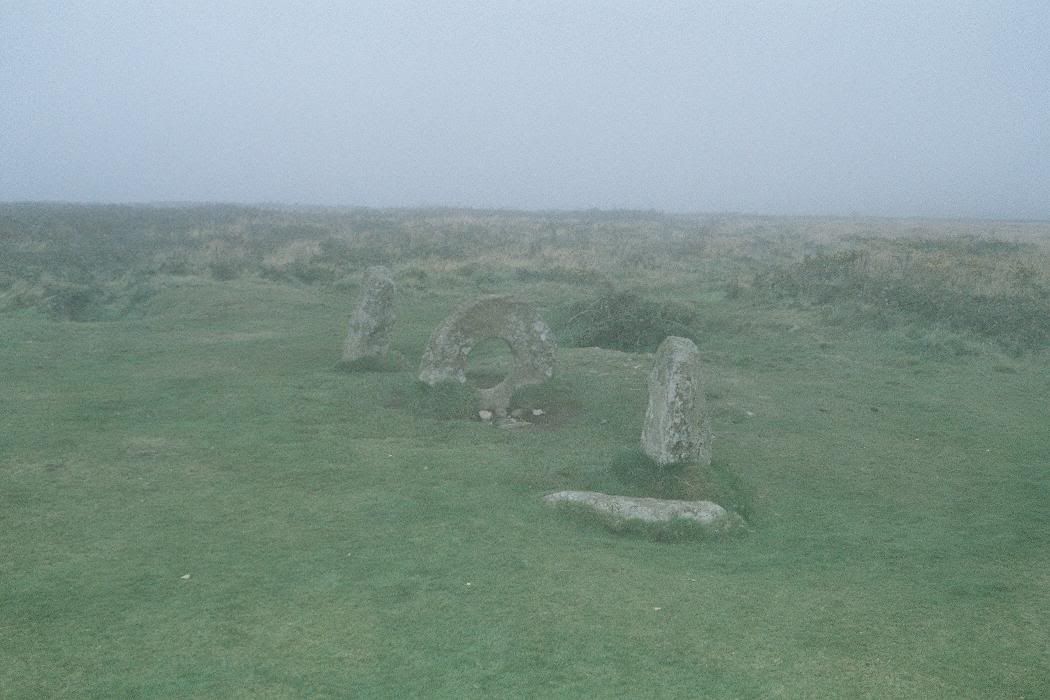
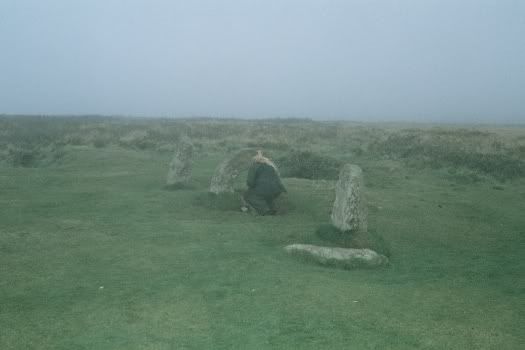
Unexpectedly, the three stones loomed at us. We stopped and stared. It was like something out of a Hollywood special effects department. The setting was one of those truly perfect moments. We moved closer, in awe of this ancient place, knowing that we were in the presence of something other, a sacred place.

Others had been there before us that day. They had left tiny offerings at the base of the hole-stone; tiny flowers picked from the surrounding countryside, bread crumbs and even some small coins. I remember thinking about these previous visitors and wondered what they had asked for as they left their gifts. M and I wandered around and decided that it would only be beneficial to us and we crawled through the stone a few times and walked in a sunwise circle about the stones. A feeling of sheer euphoria and breathlessness came over me and I had to sit down for a bit. It was as if the scene had been set, exclusively for us. It was perfect. I can't remember feeling healthier or happier than I ever did sitting there with the mist rolling in over us.


We left our own offerings after staying our fill and made our way back to the car, a bit quiet but so obviously touched by being there - I know, it sounds kooky and dramatic but it was exactly as I tell it. I can't remember ever feeling so in touch with the raw energy of the world, not even at my first ever visit to Stonehenge.

Our journey back to the car seemed closer and by now not only was the mist quite thick, it had gone quite dark. I pushed thoughts of creatures in the bush out of my mind but was nevertheless relieved to pull the car-door closed behind me.

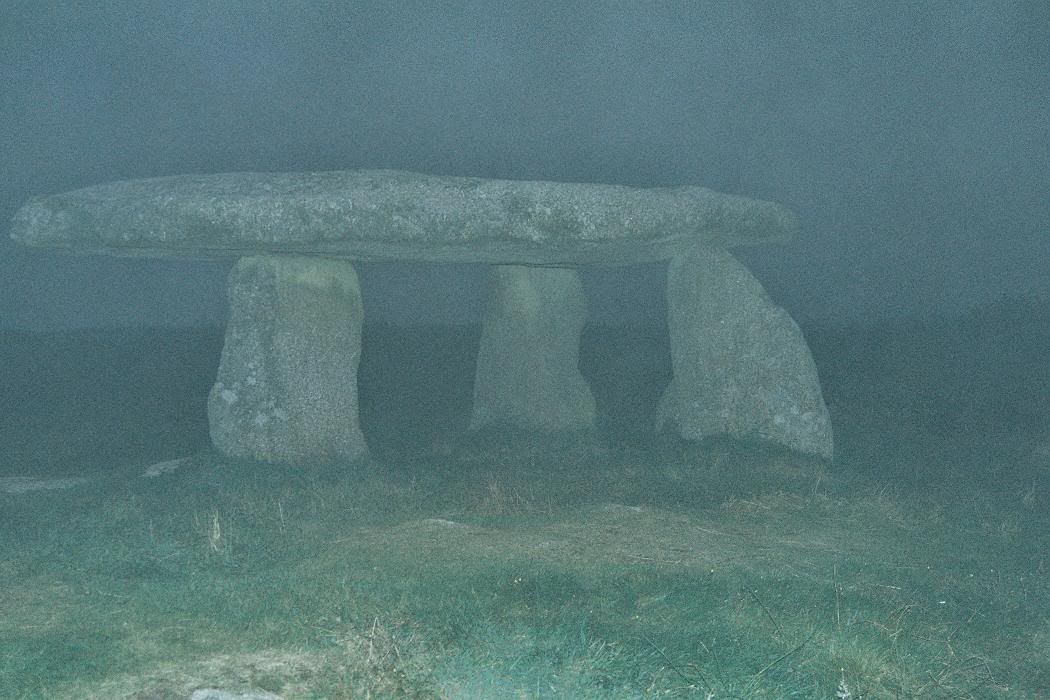
We left, feeling smug and very content, and after a few minutes drive something loomed at us out of the dark on the left hand side. Set in a small field we found another ancient tomb, this time much larger and even more eerie than you could make up. We parked the car hurriedly and clambered over a fence to go and inspect it. I didn't think that any of the pictures would come out, but they did.


And then, to crown it all, we had a full moon that night. She raced us home. We sat outside in the cottage's paddock and had some fiery whisky and toasted her. I swear she blinked at us.